
Fastest Labs Miami Airport Owner Leading With Purpose
How Monica G. Wilson is Building Three Trusted Testing Locations Across South Florida
Leadership is not about volume, it is about velocity, moving people forward with clarity and care.
– Monica Wilson
TL;DR – Monica G. Wilson, owner of Fastest Labs of Miami Airport, is expanding to three Miami locations while delivering fast, compliant, and people first testing services for businesses and families across South Florida.
Fastest Labs Miami Airport owner Monica G. Wilson is quietly building something powerful in South Florida. Not just a testing center. Not just a franchise. Instead, she is building infrastructure for trust.
In a city like Miami, where aviation, construction, hospitality, and logistics drive the economy, compliance is not optional. It is operational. Monica understands that reality. That is why she leads Fastest Labs of Miami Airport with focus, discipline, and heart.
What makes her different is simple. She sees testing as personal.
Fastest Labs Miami Airport provides drug, alcohol, DNA, and compliance services for individuals and employers across Miami. Under Monica’s leadership, the company is expanding to three locations, serving South Florida with fast, accurate, and confidential testing solutions.
Fastest Labs Miami Airport specializes in time efficient testing services designed to minimize disruption for both companies and employees. The goal is simple, help workers complete required testing quickly so they can return to work without losing valuable time during their day. This commitment to time efficiency benefits both employers and employees by keeping operations moving while maintaining full compliance.
Now, that expansion is not accidental. It reflects both demand and leadership maturity.
Monica brings more than ten years of experience in construction consulting. That background sharpened her ability to manage systems, oversee compliance standards, and operate in high stakes environments. Construction taught her logistics. Testing requires precision. The two worlds align more than most people realize.
At Fastest Labs Miami Airport, businesses rely on her team for DOT and non DOT compliance, consortium management, background checks, pre employment and random drug programs, and mobile collections. Families depend on accurate DNA testing for legal, immigration, and personal clarity needs.
According to the U.S. Department of Transportation, regulated employers must maintain strict testing standards to remain compliant and protect workplace safety. You can review federal compliance standards directly at the Federal Motor Carrier Safety Administration website. Monica ensures local companies meet those requirements confidently.
However, compliance is only part of the story.
Monica operates with what she calls the 4 D’s, Determination, Dedication, Devotion, and Discipline. Those principles guide daily operations. They also shape how clients experience her brand.
Walk into her lab and you will notice professionalism. More importantly, you will feel calm. In situations involving court admissible DNA tests or pre employment screenings, anxiety is common. Monica trains her team to respond with clarity, not pressure.
That people first approach is why Fastest Labs Miami Airport continues to grow.
Meanwhile, expansion to two additional South Florida locations signals long term vision. Miami’s workforce is growing. Aviation around the airport corridor is expanding. Construction and trade industries remain strong. Employers need partners, not vendors.
As I have seen repeatedly inside Miami’s business ecosystem, leaders who combine operational discipline with empathy tend to scale sustainably. Monica fits that model.
If you want to understand how compliance supports business stability in our region, you can also explore more workforce focused insights at MiamiBusiness.com. Education and awareness protect companies long before problems arise.
Warren Buffett once said, “It takes 20 years to build a reputation and five minutes to ruin it.” That quote fits this industry perfectly. Testing and compliance are invisible when done correctly. However, mistakes can damage reputations quickly. Monica’s commitment to accuracy, speed, and efficiency protects both families and employers from unnecessary risk.
Here is what matters most. Fast testing is valuable. Reliable testing is essential. Trust is everything.
If you are a business owner in Miami, remember this. Compliance is not an expense. It is protection. When you choose a testing partner, choose one who understands both regulations and relationships.
If you are ready to work with a locally owned business that delivers fast, accurate, and professional results, call 786-536-7315 or 954-830-9064 today and connect with Monica G. Wilson to schedule your consultation. Your workforce, your family, and your reputation deserve that level of care.

From Cool Mornings to Hot Afternoons
How March Weather Impacts Your Roof
Why Temperature Swings in Miami Can Stress Roofing Systems
Roofs don’t fail overnight. They fail after years of small movements.
– Karen Rodman
When Miami Weather Changes Quickly
March in Miami is a transitional month. Mornings can feel cool, while afternoons often return to the familiar Florida heat. These daily swings may seem harmless, but they quietly affect every roofing system across the city.
A roof responds to temperature changes throughout the day. When temperatures rise, roofing materials expand. When temperatures drop, those same materials contract. Over time, that constant movement places stress on the entire roofing system.
Why Roofing Materials Move
Every roof contains materials that react to temperature. Shingles, tiles, membranes, flashing, and sealants all expand when heated. They contract when temperatures fall.
This process happens naturally and repeatedly. Most roofs experience this cycle every single day. However, when temperature differences become larger, the movement becomes more noticeable.
In March, Miami often experiences cooler mornings followed by warm afternoons. That swing can cause roofing materials to move more than usual within a short period of time.
What Happens to Roof Seals
Sealants protect the most vulnerable parts of a roof. They seal around flashing, vents, skylights, and transitions where materials meet. These areas must remain flexible to stay watertight.
During cooler temperatures, sealants stiffen and contract. When the sun heats the roof later in the day, those materials expand again. Repeating this cycle over months and years can weaken seals.
Small cracks or separations may begin to form. At first they are invisible. Eventually they allow moisture to enter during rainstorms.
Why Flat Roofs Feel the Stress First
Flat and low slope roofs often react faster to temperature swings. Roofing membranes expand under the heat of the sun and tighten when temperatures cool.
If seams or flashing already show wear, movement can create small separations. These separations may not leak immediately. However, they can allow water intrusion once Miami’s rainy season begins.
Commercial buildings frequently experience this type of stress because large roof surfaces absorb significant heat during the day.
Tile and Shingle Roof Movement
Tile and shingle systems also respond to temperature shifts. Underlayment layers expand and contract beneath the tiles or shingles. Over time, this movement may cause small shifts in alignment.
Occasionally, tiles crack, or shingles lose adhesion. When temperatures rise again, the materials expand but the damaged seal does not always recover.
This explains why leaks sometimes appear weeks after a temperature change rather than during the weather event itself.
Miami’s Climate Makes Inspections Important
South Florida roofs experience intense sun, humidity, heavy rain, and occasional temperature swings. Each condition places stress on roofing materials.
Because of this climate, regular inspections play an important role in protecting both homes and commercial buildings. Small issues often begin quietly. Identifying them early prevents larger repairs later.
A simple inspection can reveal cracked sealants, loose flashing, or early signs of material fatigue.
A Thought Worth Remembering
Benjamin Franklin once said, “An ounce of prevention is worth a pound of cure.” His words apply perfectly to roofing systems. Understanding how daily weather affects a roof helps property owners address problems before they grow.
Takeaway
Roofs are not static structures. They expand and contract every day. March weather in Miami highlights this movement with cool mornings and warm afternoons.
Over time, these temperature swings can stress seals, flashing, and roofing materials. Paying attention to small changes today helps prevent larger issues tomorrow.
If your roof has experienced temperature swings this season, now is a good time for a professional inspection.
Karen Rodman works with homeowners, builders, and commercial property managers throughout South Florida to identify early roofing issues and keep structures protected.
📞 Call Karen Rodman305-264-3551
📧 Email Rodman RoofingRodmanroofing@yahoo.com
📍 Rodman Roofing, Inc.12151 S.W. 128th Court Unit 108, Miami, FL 33186

Record Relief in Florida: Four Legal Paths Toward a Clean Slate
A practical guide to Florida’s legal pathways for sealing or expunging a criminal record and requesting early termination of probation.
“A criminal record should not become a life sentence when the law already allowed someone to move on.” — Carolle El-Naffy
By Carolle El-Naffy | MiamiLegalNews.com
Miami has a way of reminding you that life moves fast. One minute you’re building momentum—new job prospects, new relationships, a new season—and the next, a past court case resurfaces on a background check like it happened yesterday. For many Floridians, the most frustrating part isn’t the case itself. It’s how long the “shadow” of that case can linger, even after the legal system has closed the file.
That’s why record relief matters. Not as a loophole. Not as a shortcut. But as a structured legal process that recognizes something fundamental: people are more than their worst day, and a closed case should not become a permanent obstacle to opportunity. Over the last four articles, we’ve broken down four interconnected topics that can change the trajectory of someone’s future in Florida—sealing, expungement, eligibility, and early termination of probation. Together, they tell one story: if you handle it correctly, the law sometimes gives you a way forward.
The first question people ask is the simplest—and the most important
When someone calls my office about clearing a record, they usually begin with the same line: “Can I get this off my record?” But Florida doesn’t treat every record the same way. The answer depends on a critical distinction that many people don’t learn until they’re already stuck: sealing is not expungement.
That difference is more than vocabulary. It’s the difference between a record being hidden from most public searches versus a record being removed from most public access entirely. Sealing typically restricts what the general public can see. Expungement goes further by requiring agencies to destroy records, while still allowing limited confidential retention by law enforcement. And because expungement carries that greater permanence, it often comes with tighter restrictions.
In practical terms, this distinction affects your employment options, housing applications, and professional licensing. It affects whether your case shows up on common background checks. It affects how you answer questions about your history. In other words, it affects your life. That’s why our first article began where every good legal strategy begins: clarity.
Then comes the reality check: not everyone qualifies
Once people understand the difference between sealing and expungement, the next question arrives immediately: “Okay—so which one can I do?” This is where Florida’s record-clearing laws become very strict. The system is not designed for unlimited attempts or casual filings. Eligibility is narrow, and in most situations, Florida limits record relief to one opportunity in a lifetime. That alone means you don’t want to guess.
Eligibility depends heavily on how the case ended. Generally, expungement becomes more likely when charges were dismissed, dropped, or never filed. Sealing may be possible when the case ended with a withhold of adjudication rather than a conviction. And convictions—almost always—change the equation.
Florida also draws hard lines around certain offenses. Some charges are excluded from sealing or expungement even when a case did not end in a conviction. This is where many people get surprised and discouraged, because they assume “no conviction” equals “no record problem.” But Florida public records do not work that way. Arrests and charges often remain visible unless you take legal action to address them.
That’s why our second article focused on the heart of the matter: Florida expungement eligibility isn’t a feeling—it’s a legal standard. If you don’t meet it, the court won’t grant relief, and you may waste valuable time and money. If you do meet it, you have a chance to protect your future—if you move strategically.
The process is not complicated—but it is unforgiving
Even when someone qualifies, record relief doesn’t happen because you want it to. It happens because you follow a defined process with correct paperwork, supporting documents, and the proper legal sequence. That’s what our third article tackled: how to seal or expunge a criminal record in Florida, step by step.
In most cases, the process begins with the Florida Department of Law Enforcement (FDLE). Before you can even ask a judge to seal or expunge your record, you typically must obtain a Certificate of Eligibility. That means gathering the right case dispositions, submitting fingerprints properly, completing the FDLE application, and paying the required fee. Then FDLE reviews the submission and decides whether you meet the statutory criteria.
Only after you receive that certificate can you file your petition with the court. And that petition must be correctly prepared and supported. Courts can deny petitions for technical errors, missing items, or eligibility problems that were overlooked. That’s why the process requires precision. Not drama—precision.
When done correctly, sealing or expungement can shift the way you’re viewed in the real world. It can remove a barrier to employment. It can reduce the stigma that follows a person even when they were never convicted. It can bring relief to families who have spent years trying to move past a difficult chapter. In Miami, where opportunity is often tied to credibility, a clean slate can be more than symbolic—it can be practical.
And then there’s probation—the part of the sentence people forget to finish
Some individuals can’t move forward with record relief because they’re still under court supervision. Probation is often the quiet restriction that follows someone long after the courtroom appearance ends. It can limit travel. It can restrict work options. It can create anxiety with every check-in, every condition, every requirement. And for many people, probation feels like a sentence that stretches their life into “before” and “after” indefinitely.
That’s why our fourth article focused on early termination of probation in Florida. In some cases, Florida courts allow individuals to end probation before the scheduled completion date through a legal motion. It’s not guaranteed. It’s not automatic. But it is possible—especially for individuals who have complied with all conditions, completed programs, paid fines and restitution, and demonstrated consistent responsibility.
Early termination matters because it restores time and freedom. It helps people move without the constant shadow of supervision. It allows them to take jobs that require travel or clean compliance records. And in many situations, it can become a stepping-stone toward other legal remedies—because some people can’t begin the sealing or expungement process until their probation obligations are fully resolved.
One story, four legal tools, and one consistent truth
These four articles are connected by one theme: Florida law can be strict, but it is not always without mercy. The legal system does not offer second chances casually, yet it does offer lawful pathways for people who qualify and follow the process correctly.
Sealing versus expungement teaches you what kind of relief exists. Eligibility rules tell you whether you can pursue it. The step-by-step process shows you how to do it the right way. Early termination of probation reminds you that progress can be recognized—and that supervision does not always have to last as long as the original sentence suggests.
If you’re reading this in Miami and thinking, “This sounds like me—or someone I love,” the most important step is not guessing. It’s getting a clear legal assessment of your situation, your record, your case outcome, and your eligibility under Florida law. The goal isn’t to relive the past. The goal is to remove what no longer belongs in your future.
Carolle El-Naffy is a Florida criminal defense attorney who helps individuals pursue record relief options, evaluate eligibility, and file motions when early termination of probation may be available.
📞 Call (305) 456-7576 for a confidential consultation📍 75 Valencia Ave • Suite 800 • Coral Gables, FL 33134 (By Appointment Only)
Legal Information Disclaimer
This article is provided for informational and editorial purposes only and does not constitute legal advice. Laws change and legal outcomes depend on specific facts, so readers should consult a qualified attorney regarding their individual situation. Reading this article does not create an attorney-client relationship with any attorney mentioned, MiamiLegalNews.com, MiamiBusiness.com, Wilson Alvarez, or Wilson Alvarez Consulting Group, Inc. Articles may include commentary, interviews, or ghostwritten editorial content prepared in collaboration with attorneys or legal professionals. MiamiLegalNews.com operates as a digital media publication and does not provide legal services. By reading this article, you agree that MiamiLegalNews.com and its publisher are not responsible for actions taken based on the information presented.
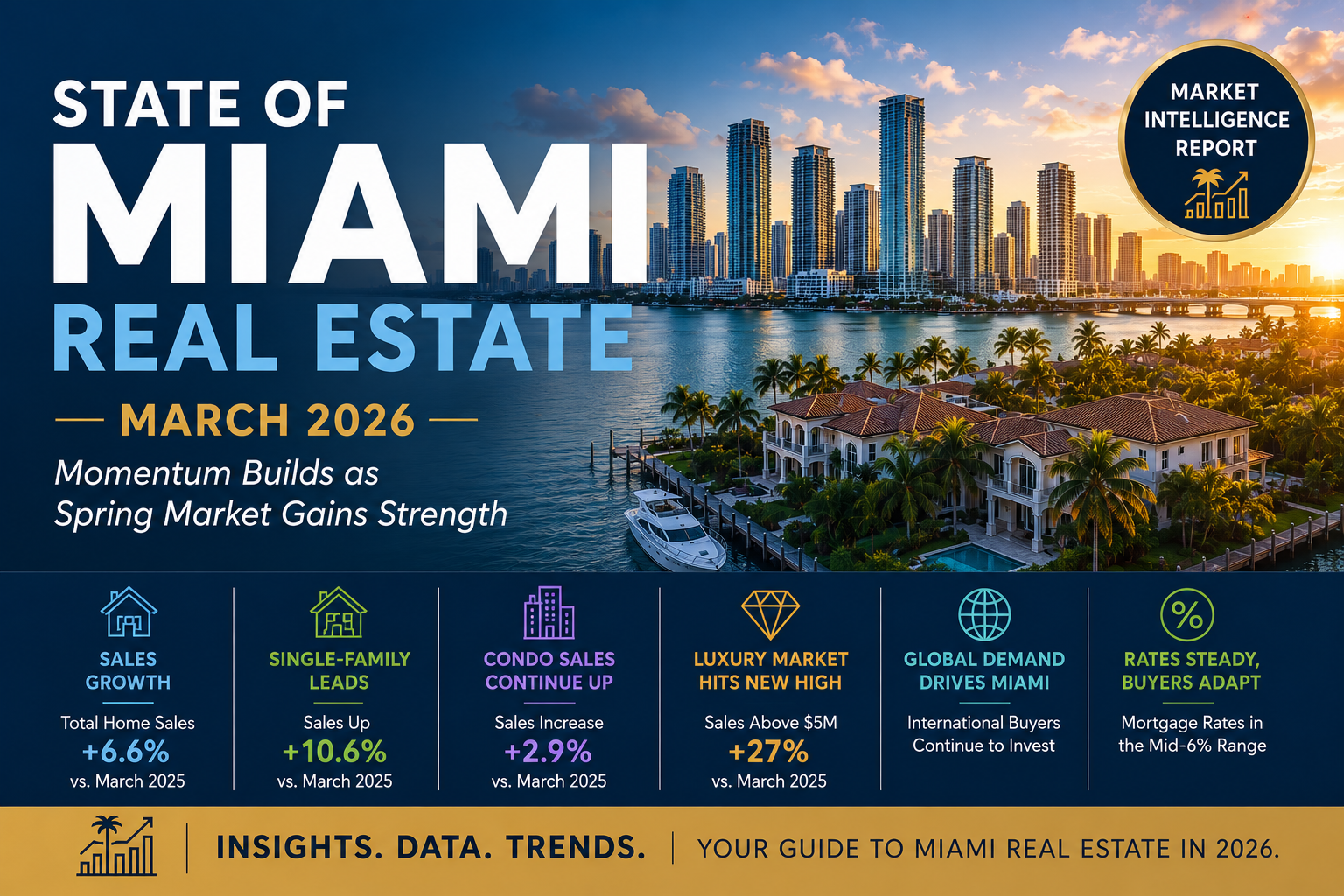
State of Miami Real Estate – March 2026
Momentum Builds as Spring Market Gains Strength
Seven consecutive months of sales growth, resilient luxury demand, and sustained international investment positioned Miami’s real estate market for one of its strongest spring seasons in recent years.
Executive Summary
March 2026 confirmed that Miami’s real estate market is no longer simply stabilizing—it is building momentum.
For the seventh consecutive month, Miami-Dade County recorded year-over-year increases in total home sales, outperforming many major U.S. housing markets despite elevated mortgage rates and ongoing affordability challenges. Total home sales increased 6.6%, led by a 10.6% increase in single-family home sales and a 2.9% increase in condominium transactions. (MIAMI REALTORS® + RWorld)
While much of the national housing market experienced a slower-than-expected start to the spring selling season, Miami continued benefiting from unique economic advantages:
Strong domestic migration
Continued international demand
High levels of cash purchases
Limited developable land
A diversified local economy
The result is a market that continues evolving—not through rapid appreciation—but through steady, sustainable growth.
Market Snapshot
March reinforced several trends that have been developing since late 2025.
Highlights included:
Total home sales up 6.6%
Single-family home sales up 10.6%
Condominium sales up 2.9%
Luxury sales above $5 million up 27%
Million-dollar single-family home sales up nearly 20% year-over-year. (MIAMI REALTORS® + RWorld)
Perhaps most encouraging was the breadth of the market.
Activity wasn’t limited to luxury properties.
Demand remained healthy across entry-level, move-up, and high-end housing, demonstrating confidence throughout multiple buyer segments.
Single-Family Homes Continue Leading the Market
Single-family homes remain Miami’s strongest residential asset.
March produced another month of double-digit sales growth while prices remained remarkably resilient.
The median single-family sale price reached $674,000, extending one of the nation’s longest appreciation streaks. Miami-Dade single-family prices have increased in 170 of the last 172 months, underscoring the long-term strength of the market. (MIAMI REALTORS® + RWorld)
Demand continues to be supported by:
Corporate relocation
Population growth
Limited land availability
Lifestyle migration
South Florida’s expanding business community
Unlike markets driven primarily by speculation, Miami’s housing demand continues to be rooted in long-term demographic and economic trends.
Condominiums Continue Their Recovery
The condominium market continued improving during March, although buyers remain highly selective.
Condo sales increased 2.9% year-over-year, marking the fifth increase in the past seven months. Median condo prices rose modestly to $445,000, continuing nearly 15 years of remarkable long-term appreciation. (MIAMI REALTORS® + RWorld)
Buyers continue focusing on:
Reserve funding
Milestone inspections
Association financial health
Insurance costs
Building management
Properties within financially strong associations continue outperforming comparable buildings facing deferred maintenance or reserve challenges.
Rather than slowing the market, these additional due diligence requirements are helping create a more transparent condominium environment.
Luxury Market Sets Another Record
Miami’s luxury market continues outperforming nearly every major metropolitan area in the country.
March saw:
27% growth in sales above $5 million
Nearly 20% growth in million-dollar single-family transactions
Almost 10% growth in million-dollar condominium sales. (MIAMI REALTORS® + RWorld)
Luxury buyers remain attracted by:
Florida’s tax advantages
International connectivity
Waterfront lifestyle
Global business opportunities
Limited trophy inventory
Cash purchases continue insulating much of Miami’s luxury sector from fluctuations in mortgage rates.
Miami Continues to Outperform National Trends
While Miami experienced another month of sales growth, the national housing market struggled with slower transaction volume.
Across the United States, existing-home sales declined during March as affordability concerns, higher mortgage rates, and consumer uncertainty weighed on buyer activity. Inventory improved modestly, but transaction volume remained below expectations. (Florida Realtors)
Miami’s continued strength highlights one of the city’s defining advantages:
Demand is being supported by global capital and long-term migration trends rather than local economic conditions alone.
Mortgage Rates Remain a Consideration—Not a Barrier
Mortgage rates remained generally in the mid-6% range throughout March.
Although borrowing costs remain elevated compared to the ultra-low rates of several years ago, buyers increasingly appear comfortable moving forward.
Many purchasers now recognize:
Interest rates fluctuate.
Home values historically appreciate.
Waiting indefinitely carries its own costs.
This shift in buyer psychology continues supporting transaction activity despite financing challenges.
Commercial Market Remains Healthy
Commercial real estate also continued demonstrating resilience.
Office demand remained supported by financial firms and professional service companies relocating to South Florida.
Industrial properties benefited from:
Port activity
Logistics
E-commerce
International trade
Mixed-use developments also continued attracting institutional investment as Miami’s urban core expands.
What Buyers Should Know
March reinforced one important message:
Opportunity still exists.
Today’s buyers enjoy:
More inventory than recent years
Improved negotiating leverage
Better financing options
More time to evaluate properties
However, the best homes continue attracting significant interest.
Preparation remains a competitive advantage.
What Sellers Should Know
The spring market continues favoring prepared sellers.
Properties that receive the strongest attention are those that combine:
Accurate pricing
Professional presentation
High-quality marketing
Responsive negotiation
Buyers remain willing to pay premium prices—but only for homes that demonstrate clear value.
Looking Ahead to April 2026
March positioned Miami for what could become one of its strongest spring selling seasons since before the pandemic.
Key trends to watch include:
Continued inventory growth
Luxury market performance
International investment
Condominium financing changes
Mortgage rate movement
While national markets continue adjusting to affordability pressures, Miami enters the second quarter with strong momentum supported by long-term economic fundamentals rather than short-term speculation.
That continues to distinguish South Florida from nearly every other major housing market in the United States.
Editorial Disclosure
This State of Miami Real Estate – March 2026 report was prepared by MiamiRealEstateNews.com using publicly available information from the MIAMI Association of REALTORS®, Florida Realtors®, MLS market statistics, and other reliable industry sources. Market statistics have been summarized and interpreted for educational and informational purposes. This report should not be considered legal, tax, financial, or investment advice. Readers should consult qualified professionals before making real estate decisions. (MIAMI REALTORS® + RWorld)
The State of Education February 2026
Every student’s success begins with a community that believes in their potential.
-Wilson Alvarez
Miami-Dade Education February 2026: Highlights & Achievements
In February 2026, Miami-Dade education is focusing on student mental health, expanding technology programs, and celebrating academic achievements across high schools, colleges, universities, and private schools throughout the county.
Education in Miami-Dade County continues to grow as schools, colleges, and universities work to prepare students for success. This February, the district emphasized programs that strengthen learning, improve academic performance, and support student well-being. For more context, you can check our January 2026 Miami-Dade education update.
Miami-Dade Education February 2026: School Board Updates
The Miami-Dade County Public Schools Board spent February reviewing student support programs and academic goals. Key priorities included:
Student mental health support: Expanded counseling and wellness programs funded.
Literacy improvement: Reading specialists and teacher training programs introduced to boost literacy rates in middle and high schools.
Campus safety and facilities: Security upgrades and facility improvements to ensure safe learning environments.
For detailed updates, visit Miami-Dade County Public Schools programs.
High School Achievements in Miami-Dade Education February 2026
High schools across the county celebrated academic and cultural milestones:
Black History Month programs: Research projects, musical performances, and cultural exhibitions.
STEM competitions: Robotics teams and science clubs participated in regional contests, emphasizing technology education.
College preparation: Guidance counselors assisted seniors with applications, scholarships, and tutoring for spring exams.
These initiatives demonstrate how Miami-Dade high schools balance rigorous academics with cultural enrichment and student engagement.
Miami-Dade Colleges and Education Highlights February 2026
Miami Dade College, one of the largest and most diverse colleges in the U.S., had a busy February:
Career and internship fairs: Connecting students with local employers.
Technology in classrooms: AI tools and virtual simulations enhanced hands-on learning.
Community service projects: Reinforcing civic engagement across Miami-Dade.
Explore scholarship opportunities at Miami Dade College for more student resources.
University Research and Miami-Dade Education February 2026
Universities continued leading in research and innovation:
Research conferences: Florida International University and the University of Miami highlighted innovations in healthcare, climate science, and business analytics.
Student-faculty collaborations: Mentorship and real-world career experiences.
Expanded scholarships: Supporting first-generation college students to improve access to higher education.
Private Schools and Community Engagement in Miami-Dade Education
Private schools actively promoted academics, sports, and social responsibility:
Competitions and tournaments: Developing leadership and teamwork skills.
Charity drives: Supporting local food banks and shelters.
Parental involvement: Volunteering and participating in school programs strengthens school communities.
A Quote to Reflect On
“Education is the passport to the future, for tomorrow belongs to those who prepare for it today.” — Malcolm X
This quote perfectly reflects the mission of educators across Miami-Dade County: today’s lessons prepare students to lead tomorrow.
February 2026 Takeaways
Collaboration between schools, families, and communities strengthens Miami-Dade’s education system. When teachers, parents, and students work together, the impact is meaningful and lasting.
Stay engaged: attend school board meetings, support local schools, and celebrate the achievements of students throughout the county. Education thrives when the community participates.