Select Page

Communities

Widgetized Area

This panel is active and ready for you to add some widgets via the WP Admin

North Bay Village, Florida, offers a selection of accommodations to suit various preferences and budgets. Here are some hotels in and around the area:

North Bay Village, FL

A midscale, smoke-free hotel featuring a heated outdoor swimming pool, exercise room, and on-site restaurant and lounge. Conveniently located 12 miles from Miami Airport.

North Bay Village, FL

A clean and safe accommodation option with street parking, located 20 minutes from Miami. Guests appreciate its convenient location and friendly staff.

North Bay Village, FL

Offers spacious apartments with excellent views of Biscayne Bay, easy parking, and a well-equipped kitchen. Ideal for families and longer stays.

North Bay Village, FL

Provides large rooms with comfortable accommodations, including kitchen facilities. Guests enjoy the home-like atmosphere and good cleaning service.

North Bay Village, FL

Offers budget-friendly accommodations with basic amenities. Some guests have noted areas for improvement in cleanliness and maintenance.

These options provide a range of amenities and price points to cater to different traveler needs in North Bay Village.

Before You Call the Bank, Call Association Lending Services

Why Starting With the Right Lending Relationships Can Save Time and Open More Financing Possibilities

When a condominium association, commercial property owner, developer, or real estate investor needs financing, the first instinct is often simple: call the bank.
But is one bank really the best place to start?
Errol Eisinger believes there is a better approach. With more than 50 years of experience in commercial real estate, banking, and lending, Eisinger has learned that the institution a borrower approaches can be just as important as the strength of the transaction itself.
That is why his message today is straightforward:
“We want to be your first choice, not your last choice, when you need financing.”
— Errol Eisinger
TL;DR
Association Lending Services helps borrowers explore financing through multiple lending relationships rather than beginning with a single bank. By reviewing the transaction first and identifying lenders whose criteria may fit the financing request, ALS seeks to save borrowers time and provide more possibilities from the beginning.
Why Starting With One Bank Can Limit Your Options
Banks do not all evaluate loans the same way.
One institution may have an appetite for condominium association lending, while another may be more interested in commercial real estate. Certain lenders may have restrictions involving rental percentages, litigation, delinquencies, property types, loan sizes, or other underwriting factors.
A borrower typically does not know those preferences before submitting an application.
Errol does.
Through Association Lending Services, Eisinger works with a network of financial institutions, including niche banking relationships outside Florida. Instead of automatically sending every transaction to the same institution, the objective is to understand the financing request and determine which lending relationship may be appropriate.
That can make ALS valuable before a borrower starts approaching banks individually.
One Financing Request Can Have Multiple Possibilities
Think about financing as finding the right fit.
A loan that does not meet one institution’s guidelines may fit another lender’s criteria. That does not necessarily make one bank better than another. It means lenders have different appetites for different types of transactions.
Association Lending Services works across several areas, including condominium association loans, commercial real estate financing and private financing for investment properties.
For condominium associations in particular, financing needs can arise quickly.
Leaky roofs, structural and balcony repairs, spalling, pool repairs, sprinkler system installation, engineering studies, landscape revitalization, management changes, accounting services and insurance renewals can place significant pressure on an association’s finances.
When reserves are insufficient, boards may face substantial special assessments. Uncompleted repairs and financial issues can also create complications for individual unit owners seeking financing or trying to sell their properties.
Association financing can provide another way to address those needs.
Experience Helps Determine Where a Loan Belongs
Eisinger’s perspective comes from having worked on multiple sides of real estate finance.
His career began in real estate accounting before he moved into commercial banking as a commercial loan officer. He has also spent decades investing in real estate and has firsthand condominium association experience as both a board member and association president.
That combination matters because lending is rarely just about completing an application.
Understanding financial statements, property operations, association issues, collateral, lender expectations and the people behind a transaction can help determine where a financing request should be presented.
ALS also performs an initial underwriting review. According to Eisinger, once the necessary financial reports and required documentation have been received, their underwriting process can generally be completed within 48 to 72 hours before working through their established financial-institution relationships.
As Errol likes to emphasize, time is money.
Helping Associations—and the Vendors Who Serve Them
Financing also affects the companies performing necessary work.
A condominium may need a roofer, engineer, contractor, sprinkler company, landscaper, CPA, property management company or another specialist. The association may know the work needs to be completed but still face the fundamental question: How are we going to pay for it?
Association Lending Services seeks to help bridge that gap.
By helping associations explore financing for necessary projects, ALS can help communities move forward while helping ensure the professionals performing the work have a viable path toward payment.
That philosophy is also behind Eisinger’s developing Alliance of Independent Vendors, a referral network designed to connect professionals serving condominium associations while creating additional opportunities for participating businesses.
First Choice, Not Last Choice
Perhaps the biggest misconception Eisinger wants to change is that alternative lending professionals should only be contacted after a traditional bank declines a loan.
He believes that approach has it backwards.
Waiting until several lenders have already reviewed or rejected a transaction can consume valuable time. Starting with someone who understands different lending appetites may provide a clearer path from the outset.
Association Lending Services cannot guarantee that every financing request will be approved. Lending remains subject to underwriting, documentation, lender requirements and the circumstances of each transaction.
But borrowers can begin by asking a better question.
Instead of “Which bank should I call?”, ask:
“Who can help me determine which lender I should be talking to?”
For Errol Eisinger, that is precisely where Association Lending Services belongs.
Make ALS Your First Call
Before approaching a single bank, talk with someone who can look at the broader financing picture.
Whether the need involves a condominium association, commercial real estate transaction or investment property, Errol Eisinger and Association Lending Services can review the situation and explore potential financing avenues through their lending relationships.
Errol Eisinger | Partner
Association Lending Services
📞 786-205-9842
✉️ eeisinger@associationfinancing.org
🌐 associationfinancing.org
Your financing search has to start somewhere. Start with experience.

Read More

Primary Care, Urgent Care, or the ER? How to Know Where to Go

Understanding the different roles of primary care, urgent care, and emergency care can help you make more informed decisions when you need medical attention.
“Knowing where to seek care is important, but having a primary care physician who knows you gives you something equally valuable—an ongoing healthcare relationship.”
— Dr. Juan Dangond
TL;DR
Primary care, urgent care, and the emergency room serve different purposes. Primary care is generally appropriate for routine healthcare, preventive services, chronic condition management, and many non-emergency illnesses or concerns. Urgent care can provide treatment for many non-life-threatening problems when your regular physician isn’t available. Emergency departments are equipped for serious or potentially life-threatening conditions. If you believe you are experiencing a medical emergency, call 911 or seek emergency care immediately.
When Something Happens, Where Do You Go?
It’s a question almost everyone has faced.
You wake up feeling sick.
A symptom you’ve been watching changes suddenly.
You develop a fever.
You injure yourself.
Or something simply doesn’t feel right.
Then comes the decision:
Do I call my primary care doctor? Do I go to urgent care? Or is this something that requires the emergency room?
There isn’t one answer that applies to every symptom or every person. Your age, medical history, medications, existing conditions, severity of symptoms, and other factors can influence the appropriate level of care.
However, understanding what each type of healthcare setting is designed to do can make the system easier to navigate.
When Primary Care May Be the Right Place to Start
Your primary care physician is responsible for much more than annual physicals.
Primary care commonly includes preventive care, routine examinations, health screenings, chronic disease management, medication management, follow-up care, and evaluation of many non-emergency illnesses and symptoms.
For appropriate non-emergency concerns, starting with a physician who already knows you can have an important advantage: context.
Your doctor may already be familiar with your medical history, current medications, previous test results, and ongoing health concerns.
At Dangond Direct, that continuity is a fundamental part of the Direct Primary Care model.
Rather than treating every visit as an isolated encounter, Dr. Juan Dangond and his patients have the opportunity to develop an ongoing healthcare relationship.
What Is Urgent Care For?
Urgent care centers occupy an important space between routine primary care and hospital emergency departments.
They generally treat medical problems that require prompt attention but do not appear to be life-threatening.
Depending on the facility and the individual situation, urgent care may evaluate concerns such as minor injuries, some infections, minor burns, sprains, uncomplicated respiratory illnesses, or other non-emergency conditions.
Urgent care can be particularly useful when your regular physician isn’t available or when you need timely evaluation of a non-emergency problem.
However, urgent care does not replace the emergency department for serious or potentially life-threatening conditions.
When Should You Go to the Emergency Room?
Emergency departments are designed and equipped to evaluate serious medical problems, including potentially life-threatening illnesses and injuries.
Warning signs can vary, and no online article can determine whether an individual situation is an emergency.
Examples of symptoms that can warrant emergency evaluation include severe difficulty breathing, signs of a stroke, severe or persistent chest pain or pressure, major trauma, uncontrolled bleeding, loss of consciousness, severe allergic reactions, or other symptoms that appear serious or life-threatening.
If you believe you or someone else may be experiencing a medical emergency, call 911 or seek emergency medical care immediately. Do not delay emergency care while waiting for a response from a primary care practice.
Where Direct Primary Care Changes the Experience
Here’s where the conversation becomes particularly relevant to Dangond Direct.
Many healthcare decisions aren’t obvious emergencies.
They’re questions.
Is this something I should have checked?
Should I schedule an appointment?
This medication is bothering me—what should I do?
This symptom hasn’t gone away. Should I be concerned?
These questions often occur between appointments.
In many traditional healthcare settings, getting guidance from your regular physician can sometimes involve navigating phone systems, leaving messages, or waiting for an available appointment.
Direct Primary Care is designed differently.
Dangond Direct members have communication options that include phone, text, and email, making it easier to communicate with the practice about appropriate healthcare questions.
That doesn’t turn primary care into emergency medicine.
It creates access.
And access can be enormously valuable when you’re trying to determine the appropriate next step for a non-emergency health concern.
Knowing Your Doctor Adds Context
Access becomes even more meaningful when the physician on the other end already knows you.
Consider the difference between explaining a concern to someone you’ve never met and discussing it with a physician who is already familiar with your medical history.
Your previous conversations matter.
Your medications matter.
Your existing conditions matter.
Your recent laboratory results may matter.
That’s why continuity has been such an important theme at Dangond Direct.
The relationship provides context.
Not Every Healthcare Decision Has to Begin With a Waiting Room
Direct Primary Care doesn’t eliminate the need for specialists, urgent care centers, hospitals, or emergency departments.
Each serves an important role.
Instead, DPC changes the primary care relationship.
When appropriate, your primary care physician can be part of the conversation earlier.
Sometimes that means scheduling an office visit.
Sometimes further testing may be appropriate.
Sometimes another healthcare setting may be recommended.
And sometimes a question simply needs a conversation.
The important distinction is that patients have an established place to begin for appropriate non-emergency primary care concerns.
Primary Care, Urgent Care and Emergency Care Have Different Jobs
The goal shouldn’t be to declare one setting “better” than another.
The goal is to use each appropriately.
Primary care provides ongoing healthcare, prevention, chronic condition management, and evaluation of many routine and non-emergency concerns.
Urgent care can provide timely evaluation for many non-life-threatening conditions, particularly when regular primary care isn’t available.
Emergency departments provide the resources necessary to evaluate potentially serious and life-threatening medical conditions.
And 911 remains the appropriate response when immediate emergency assistance is needed.
Understanding those distinctions—and having an ongoing relationship with a physician who knows you—can make healthcare feel considerably less confusing.
What’s the difference between primary care, urgent care, and the ER?
Primary care provides routine, preventive, chronic, and many non-emergency healthcare services. Urgent care generally treats non-life-threatening conditions requiring prompt attention when primary care isn’t available. Emergency rooms are designed for serious or potentially life-threatening illnesses and injuries. Anyone who believes they are experiencing a medical emergency should call 911 or seek emergency care immediately.
Frequently Asked Questions
Should I call my primary care doctor before going to urgent care?
For a non-emergency concern, your primary care practice may be able to help determine an appropriate next step based on the information available. If you believe the situation is an emergency, do not wait for your primary care physician to respond—call 911 or seek emergency care.
Can Direct Primary Care replace urgent care?
Not necessarily. Direct Primary Care can provide accessible primary care and guidance for many appropriate non-emergency concerns, but urgent care facilities provide services that may be needed depending on the situation and availability.
Does Direct Primary Care replace the emergency room?
No. Direct Primary Care is not a substitute for emergency medical services. Potentially life-threatening symptoms require appropriate emergency evaluation.
Can Dangond Direct members contact the practice between appointments?
Dangond Direct members have communication options that include phone, text, and email for appropriate healthcare questions, subject to the practice’s current policies and availability.
What should I do if I’m unsure whether something is an emergency?
If symptoms appear severe, potentially life-threatening, or you believe there may be an emergency, call 911 or seek emergency medical attention. An online article should never be used to rule out an emergency.
The Value of Knowing Where to Start
Healthcare can become confusing when you don’t know where to turn.
Primary care, urgent care, and emergency departments aren’t competitors. They are different parts of the healthcare system designed for different needs.
For patients at Dangond Direct, Direct Primary Care adds something valuable to that system: an ongoing relationship with Dr. Juan Dangond and greater access to the practice for appropriate primary care questions.
Because when something changes with your health, knowing who knows you can be just as important as knowing where to go.
Dangond Direct Primary Care
7000 SW 62nd Ave., Suite 515
South Miami, FL 33143
Call or Text: (786) 567-9546
Email: info@dangonddirect.com
Dangond Direct
Healthcare Disclaimer
This article is provided for general educational and informational purposes only and does not constitute medical advice, diagnosis, treatment, or individualized guidance about where to seek care. Symptoms and medical circumstances vary by individual. If you believe you are experiencing a medical emergency, call 911 or seek emergency medical care immediately. Do not delay emergency treatment while waiting for a response from a primary care provider. Consult a qualified healthcare professional regarding individual medical concerns.

AEO Direct Answer
Primary care is generally used for routine care, prevention, chronic condition management, and many non-emergency concerns. Urgent care typically handles non-life-threatening problems requiring prompt attention when primary care isn’t available. Emergency rooms are designed for serious or potentially life-threatening conditions. If you suspect a medical emergency, call 911 or seek emergency care immediately.
Suggested Internal Links
Link this article naturally to:

Why Having a Primary Care Doctor Who Knows You Matters
You Shouldn’t Have to Start Over at Every Doctor’s Visit
Healthcare Shouldn’t Feel Complicated: Five Ways Direct Primary Care Makes Life Easier
Dangond Direct’s services or membership page

Read More

Bryant Ruano: Building Financial Strategies Around the Business Owner’s Life

How his blue-collar upbringing shaped a career serving entrepreneurs, tradespeople and their families

For Bryan Ruano, understanding a business requires more than reviewing an investment account or recommending a financial product. It begins with understanding how the company actually operates.
When Bryan meets with a business owner, he studies how the company generates revenue, reviews its profit-and-loss statements, considers its cash flow and tax position, and asks where the owner wants the business—and the family behind it—to be in the future.
The objective is not simply to identify what the business is making today. It is to understand what the owner is building.
A company may be profitable, but is it creating retirement security for its owner? Is its tax strategy aligned with its long-term objectives? Could the business operate independently if the owner stepped away? If the company were sold five years from now, what might influence its value—and what would the owner need to begin doing today to prepare?
These are the questions that guide Bryan’s work with business owners through Corrales & Co., a firm focused on integrating wealth management, proactive tax strategy, estate planning and business-exit planning.
Looking Beyond a Conventional 401(k)
Retirement planning is one area in which Bryan believes business owners may need a more customized analysis.
Many entrepreneurs are familiar with 401(k) plans, but fewer understand how a cash balance plan may fit into a broader retirement strategy. A cash balance plan is an employer-sponsored defined benefit plan. Depending on factors such as the owner’s age, employee demographics, compensation, business profitability and the plan’s design, it may permit contributions that are significantly different from those available through a 401(k).
That does not mean a cash balance plan is appropriate for every company.
The employer generally assumes ongoing funding obligations, and the plan must be properly designed, administered and maintained. Business owners must also consider the cost of covering eligible employees, the predictability of future cash flow and whether the company can support the plan over time.
Bryan’s approach begins with the business rather than the retirement product. He evaluates whether the company has sufficient and reasonably consistent profitability, what the owner hopes to accomplish and how a proposed plan could affect both the employer and its employees.
The analysis may conclude that a cash balance plan is worth considering, that a 401(k) or another arrangement is more appropriate, or that the company is not presently in a position to implement the proposed strategy.
Planning for the Eventual Value of the Business
Bryan also encourages business owners to think beyond their immediate tax bill.
An owner who wants to sell or transition a company several years from now must first understand what creates value within the business. Profitability is important, but so are reliable financial records, recurring revenue, operational systems, capable employees and the company’s ability to function without depending entirely on its founder.
Instead of waiting for a transaction to become imminent, Bryan helps owners consider the potential transaction early and work backward.
What would make the company more attractive to a future buyer? What financial or operational weaknesses could reduce its value? What personal financial resources will the owner need after leaving the business? What happens if the sale is delayed, the valuation is lower than expected or the owner ultimately decides not to sell?
No advisor can guarantee what a business will be worth five years from now. The value will depend on financial performance, market conditions, industry trends, buyer demand and numerous other factors. Nevertheless, disciplined preparation can help an owner understand the variables that may influence a future transaction.
A Potential Tax Opportunity for Certain C Corporations
One strategy that may arise in early-stage business and exit planning involves Qualified Small Business Stock, commonly known as QSBS, under Section 1202 of the Internal Revenue Code.
For qualifying stock acquired after July 4, 2025, an eligible noncorporate shareholder may potentially exclude from federal capital-gains taxation an amount generally limited to the greater of $15 million or 10 times the shareholder’s adjusted basis in the qualifying stock. The specific exclusion and holding-period rules depend on when the stock was acquired and whether all statutory requirements are satisfied.
This is not a general exemption for every C corporation, and it should not be characterized as an automatic tax “loophole.”
Eligibility depends on several requirements involving the corporation, its assets, its business activities, the issuance of the stock and the shareholder’s holding period. Certain professional services, financial businesses, banking, insurance, hospitality and other activities may be excluded. State tax treatment may also differ from federal treatment.
Because qualification can depend on decisions made when a company is formed or when shares are issued, the subject may need to be addressed well before a potential sale. Business owners considering such a strategy should work with qualified tax and legal professionals to determine how the law applies to their circumstances.
When Wealth Exists but Cash Is Temporarily Unavailable
The case study supplied by Corrales & Co. illustrates another situation Bryan and his colleagues may help a business owner evaluate: the difference between wealth and liquidity.
A person may have considerable net worth spread across a company, real estate, retirement accounts and taxable investments, yet still lack the cash required for an immediate business or personal obligation.
Consider a hypothetical owner who needs $250,000 within several weeks but expects a liquidity event approximately 60 days later. The need might involve business working capital, payroll timing, a real estate transaction, a tax payment or another time-sensitive commitment.
The planning question is not automatically, “How can this person borrow?” It is: “Which available option presents the most appropriate combination of cost, timing and risk?”
One possibility may be a securities-backed line of credit, or SBLOC. This type of credit line uses eligible securities in a non-retirement investment account as collateral, allowing the investments to remain in the account while they secure the loan.
An SBLOC may provide temporary access to capital without requiring the borrower to sell investments immediately. However, keeping the investments also means remaining exposed to market fluctuations. The interest rate may be variable, and a decline in the pledged portfolio can result in a maintenance call.
If the borrower cannot provide additional collateral or repay the required amount, the lender may sell pledged securities—potentially without allowing the borrower to choose what is sold. That liquidation may occur during unfavorable market conditions and may create tax consequences. SBLOCs are generally demand loans, and their proceeds cannot be used to purchase or carry securities. Retirement accounts generally cannot be pledged.
For those reasons, the presence of an available credit line does not mean borrowing is the right answer.
The alternatives should also be evaluated. Selling securities may generate taxes and permanently reduce market exposure. A mortgage, home-equity line or business loan may involve additional underwriting, closing costs or delays. Waiting for the anticipated cash event may be the least expensive choice if postponement does not create a meaningful consequence.
Before considering an SBLOC, the owner and advisors should identify what is expected to repay it, how reliable that repayment source is and what the contingency plan would be if the money arrives late or is smaller than expected.
As the case study emphasizes, this is often a sequencing problem rather than a solvency problem. The objective is not to create permanent leverage. It is to determine whether temporary borrowing, selling another asset, using conventional financing or simply waiting offers the most appropriate path after the trade-offs have been examined.
Honoring His Blue-Collar Roots
Bryan’s commitment to business owners is deeply personal.
He was raised in Guatemala by blue-collar parents. From an early age, he saw the discipline, sacrifice and physical effort required to earn a living and support a family. That upbringing gave him a lasting respect for people who build their livelihoods with their hands, skills and determination.
Today, he feels a particular connection to general contractors, plumbers, electricians and other skilled-trade business owners.
Many of these entrepreneurs have spent years becoming exceptional at their craft. They have created jobs, served their communities and assumed the risks of ownership. Yet they may devote so much attention to customers, employees and daily operations that their own retirement, tax and succession planning receives less attention.
Bryan sees serving these businesses as one way of honoring his upbringing and the work ethic his parents demonstrated.
His purpose is not to separate the owner’s personal financial life from the company. It is to recognize that, for many entrepreneurs entrepreneurs, the two are inseparable. The business may represent the owner’s primary income, largest asset, retirement plan and family legacy.
His Five-Year Vision Is About Family
When Bryan is asked where he sees himself in five years, his answer is not limited to revenue or professional growth.
Within approximately two years, he would like his wife to join the business. During the following three years, he hopes to strengthen the company’s infrastructure, develop its team and implement systems that allow it to operate effectively without requiring his constant physical presence.
His personal objective is to spend approximately two months each summer with his wife and daughters.
Bryan expects that technology—including video meetings, cloud-based platforms and modern telephone systems—will allow him to remain accessible when genuinely necessary. However, his larger goal is to build an organization with people and processes capable of serving clients consistently while he is away.
In many respects, it is the same principle he discusses with other entrepreneurs: a strong business should eventually provide its owner with choices.
That does not happen automatically. It requires documented procedures, dependable employees, appropriate technology and a willingness to develop leaders who can make decisions without the founder controlling every detail.
For Bryan, business growth is not an end in itself. It is a way to create time, strengthen family relationships and ensure that years of hard work produce something enduring.
His professional and personal goals ultimately share the same purpose: transforming business success into greater freedom, security and meaning.
Start With a Clearer Picture of Your Business
If you are a business owner considering retirement-plan options, preparing for a future transition or evaluating how your company fits into your personal financial life, the first step is understanding where you stand today.
Connect with Bryant Ruano and Corrales & Co. to begin a conversation about your business, priorities and long-term objectives.
Call Bryant Ruano at 786-707-7796 or visit CorralesCo.com to learn more or request a consultation.
A consultation does not guarantee that any particular strategy, product or service will be recommended or available. Any recommendations must be based on the client’s individual circumstances and completed review.

Important Disclosures
This article is provided for general informational and educational purposes only. It is not intended as an offer, solicitation, recommendation, or individualized investment, lending, retirement-plan, tax, accounting or legal advice. The strategies discussed may not be appropriate or available for every business owner or investor.
Cash balance plans are subject to funding, plan-design, nondiscrimination, administration and other legal requirements. Qualified Small Business Stock treatment under Section 1202 of the Internal Revenue Code depends on the corporation, shareholder, stock issuance, holding period, business activity and other applicable requirements. Federal and state tax treatment may differ. Business owners should consult qualified tax, legal and retirement-plan professionals regarding their individual circumstances.
A securities-backed line of credit, or SBLOC, uses eligible securities as collateral. A decline in the value of pledged securities may result in a maintenance call, a demand for additional collateral or repayment, or the involuntary sale of securities. The lender may sell pledged securities without advance notice and without allowing the borrower to select which securities are sold. Such a sale may occur under unfavorable market conditions and may create tax consequences. Interest rates and borrowing costs may increase. SBLOCs are generally demand loans, and proceeds may not be used to purchase or carry securities. Qualified retirement accounts generally may not be pledged. Eligibility, rates, terms and collateral requirements are determined by the lender.
Any discussion of potential business value, tax treatment, liquidity or financial outcomes is illustrative and does not guarantee a particular result. Actual outcomes depend on individual circumstances, market conditions, applicable laws and other factors that may change over time.
Investment products are not FDIC insured, are not bank guaranteed and may lose value. Readers should consult their own financial, tax and legal professionals before implementing any financial strategy.
Additional information about securities-backed lines of credit and their risks is available through FINRA.

Read More

Five Technology Shifts Reshaping Miami Businesses

From artificial intelligence to cyber resilience, technology decisions have become leadership decisions

For Miami business owners, technology used to be something addressed after the larger business decisions had already been made. A company selected its office, hired employees, established its procedures and then called an IT provider to connect the computers.
That order has changed.
Technology now influences nearly every part of a business: how employees collaborate, how customers are served, how money moves and how quickly operations can recover after a disruption. Artificial intelligence and automation are also changing expectations about how fast companies should work and respond.
Yet progress brings risk. The same tools that help a growing company operate more efficiently can introduce new security, privacy and operational concerns when adopted without sufficient planning.
Here are five technology shifts Miami business leaders should be watching.
1. Artificial Intelligence Is Entering Daily Operations
Artificial intelligence has moved beyond experimentation. Businesses are using AI to summarize meetings, prepare draft communications, analyze information, assist customers and automate portions of routine workflows.
For smaller companies, that accessibility can be transformative. A team does not need an internal data-science department to benefit from AI-assisted tools.
The challenge is ensuring that convenience does not replace judgment.
AI systems can produce inaccurate information, overlook context and expose sensitive information when employees enter business or customer data into unapproved services. Companies therefore need policies defining which tools may be used, what information employees may share and when a person must verify the output.
AI should enhance employee capabilities while preserving human responsibility for the final decision.
2. Cloud Services Require More Than a Subscription
Microsoft 365, Google Workspace and other cloud platforms have helped businesses support multiple offices, remote employees and mobile work. Documents, email and collaboration tools can now be accessed from almost anywhere.
However, cloud availability should not be confused with a complete backup and recovery strategy.
Every cloud platform has its own retention policies, administrative controls and recovery limitations. Accidental deletion, compromised accounts, malicious changes and ransomware can still affect cloud-based information.
Businesses should know exactly what information is protected, how long deleted files remain recoverable and how operations would continue if a critical service became unavailable.
A successful cloud strategy brings together accessibility, security, backup and recovery rather than treating them as separate concerns.
3. Automation Is Changing How Work Gets Done
The most valuable automation projects are not always the most ambitious. In many organizations, meaningful improvements begin with a repetitive task that employees perform every day.
Appointment reminders, invoice processing, customer follow-ups, document approvals and internal notifications can often be streamlined. Automating these processes can reduce errors while allowing employees to spend more time on customers and higher-value work.
Before selecting an automation platform, leaders should identify the business problem they are trying to solve. They should also decide who will own the automated process and what happens when an unusual situation requires human attention.
Technology alone cannot repair a poorly designed workflow. The process must be understood before it can be improved.
4. Cybercriminals Are Becoming More Convincing
Many cyberattacks no longer begin with someone breaking through a technical barrier. They begin by convincing an employee to open a link, disclose a password or approve a fraudulent transaction.
The FBI identified phishing and spoofing among the most frequently reported forms of cybercrime in its 2024 Internet Crime Report. The bureau has also warned that criminals are using AI-generated text and voices to impersonate trusted individuals.
That development has important consequences for businesses.
A polished email is not necessarily legitimate. A familiar voice on a telephone call may not prove someone’s identity. Even a message arriving from a known account could have been sent after that account was compromised.
Requests involving payments, credentials, banking changes or sensitive information should be confirmed using an independently verified telephone number or another trusted communication method.
Employees need permission to pause an urgent request and verify it. That moment of hesitation can prevent an expensive incident.
5. Business Continuity Is Becoming Part of Customer Service
When a company’s systems stop working, the consequences extend beyond the technology department.
Employees may be unable to access files, communicate with customers, process payments or fulfill commitments. Customers do not necessarily see a server problem or a software outage. They see a business that was unavailable when they needed it.
That makes business continuity a customer-service and reputation issue.
A recovery plan should identify the organization’s most important systems, establish who is responsible during an incident and define the order in which operations should be restored. It should also account for alternate communication methods when normal email or telephone systems are unavailable.
Backups are a critical part of this preparation, but having them is not enough. The Cybersecurity and Infrastructure Security Agency recommends maintaining and testing backups because damaged, incomplete or inaccessible copies may fail when an organization needs them most.
A successful test provides evidence that the information can be restored and helps the company understand how long recovery will actually take.
Technology Strategy Begins With Business Priorities
Digital transformation does not require a company to replace every system or adopt every new platform. In many cases, the best first step is a careful review of how the organization currently works.
Business leaders can begin by asking:

Which recurring process wastes the most employee time?
Where is the same information being entered more than once?
Which accounts still lack multi-factor authentication?
When was the company’s last successful backup restoration?
What information are employees entering into AI services?
Which system would create the greatest disruption if it became unavailable?

These questions connect technology decisions to measurable business concerns.
A Miami Technology Perspective
Local technology providers, including ulltium consulting®, encourage companies to look beyond individual products and consider how technology affects productivity, cybersecurity and business continuity as a whole.
That approach is particularly relevant in Miami’s fast-moving business environment, where organizations frequently support remote employees, multiple locations, international customers and cloud-based operations.
The goal is not to predict every technological development. It is to build an organization capable of evaluating change, managing risk and recovering when circumstances do not go according to plan.
Technology will continue evolving. The competitive advantage will belong to businesses that adopt it intentionally.

Read More

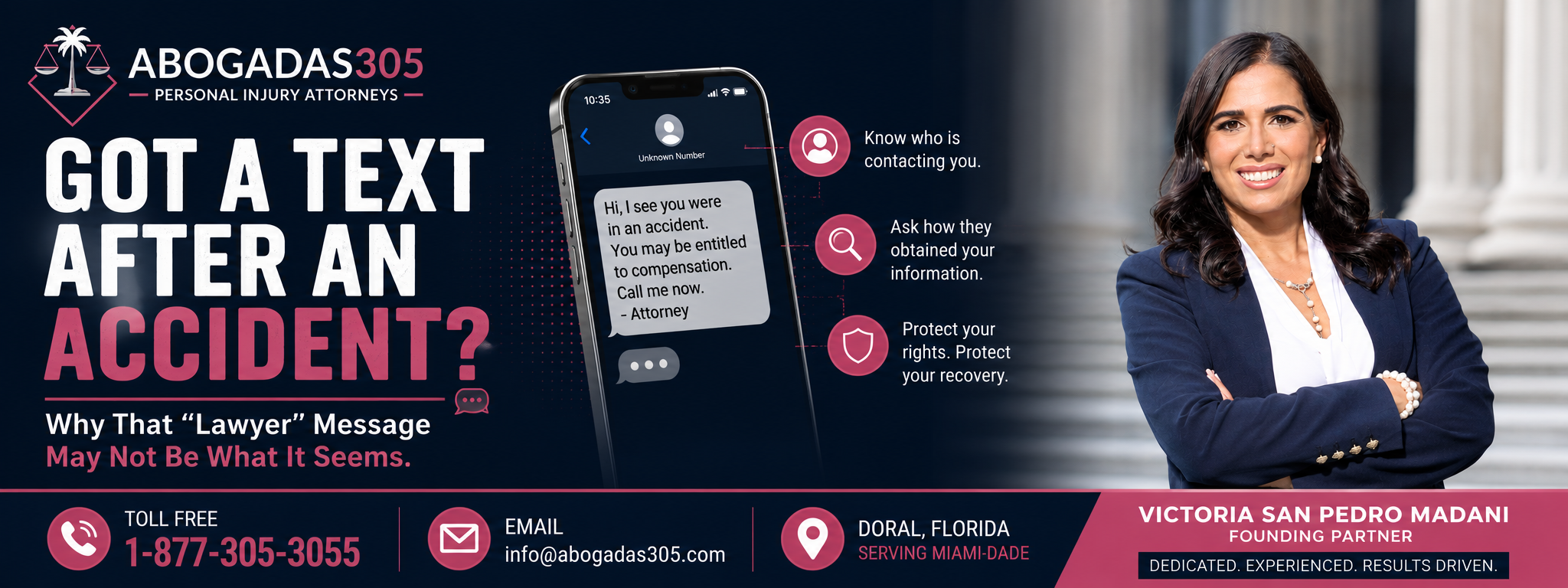
Got a Text After an Accident? Why That “Lawyer” Message May Not Be What It Seems

A Doral personal injury attorney explains why unexpected messages after an accident deserve a closer look—and why knowing who is actually contacting you matters.
“After an accident, you should be able to decide for yourself who you trust with your case. An unexpected text should never make you feel pressured, confused or misled about who is actually contacting you.”
— Victoria San Pedro Madani, Founding Partner, Abogadas305
Key Takeaways…

Receiving an unexpected text after an accident does not necessarily mean the person contacting you is your lawyer—or even a lawyer.
Florida imposes specific rules on attorneys who directly solicit prospective clients, including requirements affecting certain written and electronic communications.
Accident victims should identify who is contacting them, which organization they represent and how they obtained their information before sharing medical, insurance or personal information.
A clinic, marketing company, referral service or other third party should not simply be assumed to be a law firm because its message discusses a potential injury claim.
When in doubt, independently verify an attorney through The Florida Bar rather than relying solely on a phone number or link contained in an unexpected message.

The Text Message You Never Asked For
A car crash can create an extraordinary amount of noise in a remarkably short period of time.
There may be calls from insurance adjusters, repair shops, medical providers and family members. Police reports have to be obtained. Transportation becomes an issue. Meanwhile, an injured person may be trying to understand what happened physically while also worrying about work, bills and a damaged vehicle.
Then the phone buzzes.
The message may mention the accident. It may suggest that legal assistance is available. Perhaps it encourages the recipient to call immediately, click a link or schedule treatment.
For someone who has never been involved in a serious accident, the natural assumption may be: How does this person know about my crash?
According to Victoria San Pedro Madani, a founding partner of Doral-based Abogadas305, that is exactly the kind of moment when an accident victim should slow down and ask questions.
“People can be particularly vulnerable immediately after an accident because they are dealing with so many things at once,” Madani says. “Before responding to someone you don’t know, find out who they are and why they’re contacting you.”
That distinction matters because a message that sounds legal is not necessarily coming directly from a lawyer.
Florida Regulates Direct Solicitation by Lawyers
Florida lawyers operate under detailed advertising and solicitation rules.
The Florida Bar treats certain communications directed to prospective clients differently from general advertising that someone might encounter on a billboard, website or television commercial. Its guidance specifically addresses electronic communications and targeted solicitation. (The Florida Bar)
For example, Florida Bar guidance states that unsolicited direct communications prompted by a specific event affecting a recipient can trigger disclosure requirements, including information about how the lawyer obtained the information that prompted the communication. (Florida Bar News)
Texts also are not outside the rules simply because they arrive on a cellphone. Florida Bar guidance has addressed unsolicited text solicitations and notes that lawyers using them must comply with applicable advertising requirements as well as relevant state and federal law. (Florida Bar News)
Florida statutes add another layer. Section 877.02 addresses solicitation of legal services and makes certain forms of solicitation or procurement of legal business unlawful. (Online Sunshine)
The practical lesson for consumers is simpler than the regulations themselves:
A text message is not proof of legitimacy.
Who Is Actually Sending the Message?
This may be the most important question.
A recipient should not assume that a message discussing lawyers, accident claims or medical treatment came from an attorney.
Instead, look at the sender carefully.
Is a law firm’s complete name identified? Is an individual attorney named? Can that attorney independently be located through The Florida Bar? Does the telephone number correspond with the firm it claims to represent?
Those questions become even more important if the sender immediately asks for sensitive information.
A legitimate attorney-client relationship involves much more than a text message. Therefore, consumers should be cautious about providing Social Security numbers, insurance information, medical records, photographs, identification or other personal information to an unknown sender.
“How Did You Get My Number?”
It is a perfectly reasonable question.
Accident information can move through numerous systems. Some information associated with crashes may eventually become available through public or commercial sources, while other information may have been provided during ordinary post-accident communications.
However, knowing that information exists somewhere does not tell you who obtained it, how they obtained it or why they are contacting you.
That is why an unexpected message deserves scrutiny rather than an automatic response.
Florida Bar guidance recognizes the importance of this issue. In certain unsolicited communications prompted by a specific occurrence, the rules require disclosure regarding how the information prompting the communication was obtained. (Florida Bar News)
For an accident victim, asking “How did you get my information?” isn’t confrontational. It is basic due diligence.
A Clinic Is Not a Law Firm
Another source of potential confusion arises when legal and medical marketing begin to sound alike.
After an accident, medical treatment can be critically important. However, choosing a doctor and choosing a lawyer are separate decisions.
A medical clinic does not become a law firm because someone associated with it talks about insurance claims. Likewise, a marketing or referral company does not become your attorney simply because its representative discusses obtaining compensation.
Consumers should understand exactly whom they are dealing with.
If someone claims to represent a lawyer, ask for the attorney’s full name and firm.
Then verify it independently.
Do not rely exclusively on a link contained in the text itself. Search for the attorney through The Florida Bar’s official website and compare the information.
That simple step can answer a surprisingly important question:
Is the person being presented to me actually a Florida lawyer?
Be Careful What You Sign After an Accident
Unexpected communications are not limited to text messages.
Accident victims may also encounter documents, electronic forms, medical authorizations, insurance releases and representation agreements while they are still trying to understand what happened.
Madani frequently emphasizes the importance of knowing what a document actually does before signing it.
That does not mean every document presented after an accident is improper. It means signatures have consequences.
A person should understand whether a document authorizes medical treatment, releases information, settles a claim, retains an attorney or accomplishes something else entirely.
The same principle applies electronically.
A button labeled “continue,” “accept” or “sign” can carry considerably more significance than its appearance suggests.
Your Lawyer Should Be Someone You Chose
There is a larger principle behind all of this.
Legal representation involves trust.
An attorney may eventually learn intimate details about a client’s medical history, employment, finances and family. The attorney may communicate with insurance companies, medical providers and opposing counsel on that person’s behalf.
That relationship should begin with clarity.
Consumers should know the identity of their attorney, understand the law firm representing them and have an opportunity to ask questions about the representation.
An accident does not take away someone’s ability to make that choice.
What Should You Do If You Receive an Unexpected Legal Text After an Accident?
For someone asking, “I received a text from a lawyer after my Florida car accident—what should I do?”, the safest first step is to avoid sharing sensitive information until you independently verify the sender, the attorney and the law firm. Ask how the sender obtained your information, confirm the lawyer’s Florida Bar status through an independent source and understand exactly what you are agreeing to before signing or clicking anything.
That answer is deliberately straightforward because, in the hours and days following an accident, straightforward information can be valuable.
Technology Has Changed. The Need for Trust Hasn’t.
Marketing technology can now identify audiences, automate messages and reach people faster than ever before.
Lawyers, like professionals in nearly every industry, operate in that environment.
Yet personal injury law deals with people during moments when they may be physically hurt, financially stressed and uncertain about what happens next. Technology should not erase the distinction between marketing and an attorney-client relationship.
For Madani, consumer education is therefore part of the conversation.
Before asking whether someone has a case, there is sometimes an even more fundamental question worth answering:
Do you know who you’re talking to?

Before You Reply to That Text, Know Who Is on the Other End
If you’ve been injured in an accident and received an unexpected message offering legal assistance, you don’t have to make a decision from that text thread.
Abogadas305 invites prospective clients to contact the firm directly, ask questions and determine for themselves whether the firm is appropriate for their circumstances.
Victoria San Pedro Madani
Founding Partner, Abogadas305
Abogadas305 – Personal Injury Attorneys
8400 NW 33rd Street, Suite 405
Doral, FL 33122
Toll Free: 1-877-305-3055
Email: info@abogadas305.com
Visit Abogadas305
Before you trust the message, verify the messenger.

Legal Disclosure
This article is provided for general informational and educational purposes only and does not constitute legal advice. Reading this article, visiting a website, sending an email or contacting Abogadas305 does not by itself create an attorney-client relationship. Laws, regulations and professional rules may change, and their application depends on the specific facts and circumstances involved.
No statement in this article is intended to guarantee, predict or imply a particular outcome in any legal matter. Every case is different, and prior results do not guarantee a similar outcome. Individuals seeking advice regarding a specific accident, communication, solicitation or potential legal claim should consult a qualified attorney regarding their individual circumstances.


Read More