
Select Page

Communities

Widgetized Area

This panel is active and ready for you to add some widgets via the WP Admin

North Bay Village, Florida, offers a selection of accommodations to suit various preferences and budgets. Here are some hotels in and around the area:

North Bay Village, FL
A midscale, smoke-free hotel featuring a heated outdoor swimming pool, exercise room, and on-site restaurant and lounge. Conveniently located 12 miles from Miami Airport.

North Bay Village, FL
A clean and safe accommodation option with street parking, located 20 minutes from Miami. Guests appreciate its convenient location and friendly staff.

North Bay Village, FL
Offers spacious apartments with excellent views of Biscayne Bay, easy parking, and a well-equipped kitchen. Ideal for families and longer stays.

North Bay Village, FL
Provides large rooms with comfortable accommodations, including kitchen facilities. Guests enjoy the home-like atmosphere and good cleaning service.

North Bay Village, FL
Offers budget-friendly accommodations with basic amenities. Some guests have noted areas for improvement in cleanliness and maintenance.

These options provide a range of amenities and price points to cater to different traveler needs in North Bay Village.
The State of Insurance August 2025

Miami-Dade Insurance August 2025: Key Updates and Insights
August 2025 is a critical month for Miami-Dade insurance policyholders. With hurricane season peaking, residents and businesses are evaluating coverage, costs, and preparedness strategies. Here’s what’s happening in the Miami-Dade insurance market this August 2025.

Hurricane Season in Miami-Dade: Insurance Preparedness
August is historically one of South Florida’s most active storm months. Local agencies recommend:

Reviewing homeowners, flood, and windstorm policies

Checking hurricane deductibles and coverage limits

Adding flood insurance in FEMA-designated zones (FEMA Flood Map Center)

Following local storm updates via the Miami-Dade Emergency Management page

Many agencies are offering free policy checkups this month to ensure no gaps in coverage.

Market Trends: Miami-Dade Insurance Premiums and Discounts
Despite high costs, some Miami-Dade insurers are offering storm-preparedness discounts for upgrades like impact windows, shutters, or reinforced roofing. Key trends include:

Premium increases in high-risk flood zones

Loyalty rewards for long-term customers

Stricter underwriting based on updated FEMA flood maps

For more guidance, check out resources from the Florida Office of Insurance Regulation.

Auto and Commercial Insurance in Miami-Dade County
Commercial property owners should prepare for mid-season rate changes as insurers adjust risk assessments. Auto insurance companies are also introducing safe-driver apps to reward policyholders for cautious driving habits.

New Insurance Agencies in Doral and Coral Gables
August 2025 brings new opportunities for residents to connect with local, bilingual insurance agents. Agencies opening in Doral and Coral Gables are focusing on:

Personalized coverage support

Explaining complex deductibles

Helping families in underserved areas

Visit 305SocialMedia.com’s insurance marketing insights for business and insurance updates.

Ongoing Challenges for Miami-Dade Insurance Policyholders
Even with new agencies and incentives, challenges persist:

Rising premiums that outpace inflation

Limited insurer competition in coastal and flood-prone neighborhoods

Confusion over storm deductibles and policy fine print

Working with local agents who understand Miami-Dade’s unique risks is essential.

“By Failing to Prepare, You Are Preparing to Fail”
Benjamin Franklin’s famous quote resonates deeply during hurricane season, reminding residents that insurance preparation is key to financial security.

Read More

The State of Education August 2025

Miami-Dade Schools August 2025: Back-to-School News and Education Updates
As the Miami-Dade schools August 2025 academic year begins, Miami-Dade County Public Schools (M-DCPS) welcomes over 330,000 students to its 415 schools with exciting initiatives designed to enhance learning, safety, and community engagement. This year’s focus is on cutting-edge technology, improved teacher training, and expanded resources for student well-being.

Back-to-School Highlights
Students are starting the school year with access to more digital platforms, updated meal programs, and detailed online portals for parents to check bus routes, schedules, and grades. For more information, visit the Miami-Dade County Public Schools official website.

Technology and Innovation Drive Education
M-DCPS continues to transform classrooms with interactive smart boards, faster Wi-Fi, and a device distribution program ensuring every student has a tablet or laptop. New coding clubs and robotics teams promote STEM education, preparing students for the future. Learn more about STEM initiatives at STEM.org.

Teacher Development and Support
Teachers are receiving additional training in differentiated instruction, classroom management, and AI-based learning strategies. These professional development programs aim to boost student engagement and academic performance across all grade levels.

Prioritizing School Safety
Safety is a top priority this year. Schools now feature enhanced entry systems, upgraded security cameras, and expanded mental health staff. Families are encouraged to download the district’s safety app for real-time updates.

Community and Parent Involvement
Local PTAs are organizing resource fairs and volunteer opportunities to strengthen school-community bonds. Additionally, the Miami-Dade Public Library System has partnered with schools to offer homework help, tutoring, and literacy programs to students.

Looking Ahead
The Miami-Dade schools August 2025 initiatives reflect the district’s dedication to innovation, student safety, and parent engagement. With these measures in place, the school year is off to a promising start, setting the stage for student success throughout 2025.

Read More

State of Sweetwater – August 2025

 Back to Business
By Wilson Alvarez – MiamiBusiness.com

“The secret of getting ahead is getting started.” — Mark Twain

August in Sweetwater is all about rhythm. After a bustling summer filled with festivals, tourism, and record retail sales, the city turns its focus from vacation to vocation. As students return to class and professionals refocus on goals, Sweetwater’s businesses are showing that fall prep is every bit as important as summer fun.

1. The Back-to-Business Pulse
Local business owners call August their “reset month.” Offices that slowed for summer pick up pace again, and retailers begin planning fall promotions. The Sweetwater Business Alliance hosted its Annual Business Strategy Breakfast at La Fontana Banquet Hall, where over 100 entrepreneurs gathered to discuss digital trends, AI marketing, and customer-retention strategies.
Key takeaway: Sweetwater’s small businesses are embracing automation, analytics, and AI faster than ever before — making them more competitive across Miami-Dade.

2. FIU Back in Session
Florida International University has officially welcomed students back for the fall 2025 semester, bringing an estimated 57,000 students to its Modesto Maidique Campus just blocks away. The first-week economic impact is felt citywide — cafés, restaurants, and rideshare services report spikes of up to 30 percent in daily activity.
FIU also unveiled its Panther Innovation Hub, an incubator where engineering, business, and design students collaborate on real-world problems. Several Sweetwater companies are already participating as pilot partners, offering mentorship and internships.

3. Retail Rebounds After Summer Rush
Dolphin Mall remains Sweetwater’s retail crown jewel, seamlessly transitioning from summer tourism to local fall shopping. New fall inventory from brands like Aerie, Banana Republic Factory, and Puma Outlet coincides with the annual Back-to-School Super Sale, which drew thousands of families during tax-free weekend.
The mall’s new “Locals First” campaign highlights Miami-Dade-based vendors in pop-up kiosks, giving Sweetwater artisans prime visibility among national brands — a creative blend of big-box retail and local entrepreneurship.

4. Restaurants Re-Energize the Lunch Crowd
As FIU and offices reopen, Sweetwater’s dining scene is booming again.

The Green Fork Café rolled out a new vegan-friendly lunch menu.

Casa Venezolana expanded weekday hours to serve the student rush.

Taco Rico introduced a $10 “Panther Combo” for FIU students and staff.

Local owners report that Sweetwater’s mix of professionals and students provides a balanced customer base that keeps the city’s economy resilient year-round.

5. Construction & Infrastructure Updates
The Upland Park development continues ahead of schedule, with crews now framing the mixed-use retail podium. Developers confirmed that the first set of retail leases will be announced this fall, with interest from both national chains and local entrepreneurs.
Simultaneously, the Li’l Abner III project has begun vertical construction on its second residential tower. Once completed, the complex will add 300 units of workforce housing — a major milestone for affordable living in Sweetwater.

6. Community Highlights & Anniversaries

Sweetwater Cyclery launched its “Bike to Campus” initiative in partnership with FIU’s sustainability office.

Studio 305 Salon celebrated its 8-year anniversary with free back-to-school haircuts for local students.

La Esquina Boutique marked five years in business, unveiling its new fall fashion line during a pop-up runway event at Dolphin Mall.

Each of these milestones reflects a city that values community connection just as much as commercial success.

7. Safety, Security & City Services
The Sweetwater Police Department expanded its Community Ambassador Program to include FIU student volunteers who will assist with pedestrian safety during rush hours. In addition, the city’s code-compliance office launched a “Clean and Green Sweetwater” campaign encouraging storefront beautification — offering small grants to local businesses that refresh their façades before the holidays.

Takeaway
August 2025 shows that Sweetwater’s strength lies in preparation. Whether it’s a student returning to FIU, a business owner refining strategy, or a developer breaking new ground, everyone in this city shares one mindset: keep moving forward.

Read More

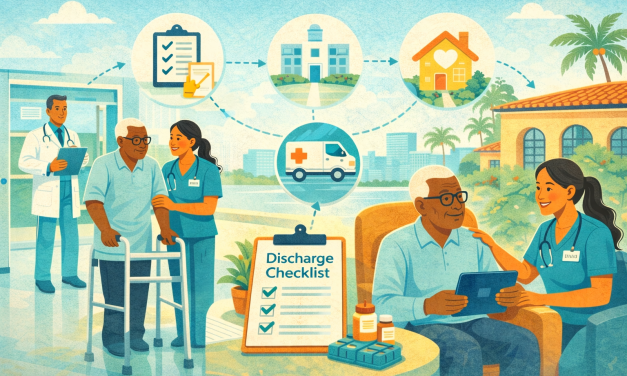
From Hospital Discharge to Home Care: What Miami Families Should Know

Your Local Matchmaker to All Things for Seniors
Why Senior Care Transitions in Miami-Dade Require More Than Paperwork
The discharge nurse says,“You’re cleared to go home tomorrow.”
And just like that, everything changes.
For many families in Miami-Dade, hospital discharge is not a relief. Instead, it often marks the beginning of uncertainty.
Who will manage medications?Is in-home care needed?What follow-up appointments are urgent?Is the home safe enough?
The hospital provides instructions. However, instructions are not coordination.
And that distinction matters.

The Hidden Complexity of Senior Care Transitions
Senior care transitions in Miami-Dade are among the most vulnerable moments in healthcare. Although discharge paperwork may appear comprehensive, it rarely provides step-by-step guidance for what happens next.
According to the Agency for Healthcare Research and Quality, poor care coordination during transitions can increase hospital readmission rates and medication errors. Therefore, what happens after discharge is just as important as the hospital stay itself.
Families typically leave with:

Prescriptions

Equipment recommendations

Therapy referrals

Follow-up instructions

Insurance documentation

However, they often leave without a clear roadmap. As a result, confusion can quickly replace confidence.

Why Paperwork Alone Is Not Enough
Although hospitals provide discharge summaries, those documents do not schedule appointments, confirm provider availability, or ensure medications are properly managed.
For example, a senior may receive a referral for physical therapy. Meanwhile, no one verifies whether the provider accepts their insurance or can begin services immediately.
Similarly, medication lists are often updated at discharge. However, families may not fully understand dosage changes or potential interactions.
Consequently, small misunderstandings can lead to larger complications.
This is why senior care transitions require active coordination — not just written instructions.

Why Miami-Dade Families Face Unique Challenges
Senior care transitions in Miami-Dade County can be particularly complex. In addition to standard healthcare challenges, local families often navigate:

Multilingual households

Layered insurance systems (Medicare, Medicaid, private plans)

A wide range of public and private providers

Cultural expectations around family caregiving

Because Miami-Dade is highly diverse, communication gaps can occur easily. Furthermore, provider networks vary widely across neighborhoods.
As a result, families without strong local knowledge may feel overwhelmed quickly.

The Role of a Healthcare Connector
This is where community-based healthcare connectors play an important role.
305Senior, founded by Viviana Laboy, serves as an independent referral hub in Miami-Dade. Rather than offering medical advice, the organization focuses on helping families identify appropriate next steps.
Specifically, it connects families with:

Licensed home health agencies

Senior living communities

Mobile physicians

Elder law professionals

Medical equipment providers

In other words, the goal is to simplify navigation. Instead of families calling multiple providers blindly, they receive direction based on local knowledge.
Ultimately, guidance reduces stress during vulnerable moments.

Questions Families Should Ask Before Discharge
Before leaving the hospital, families should pause and ask critical questions. Although the discharge process can feel rushed, taking a few extra minutes can prevent setbacks later.
For instance:

Who will manage medications at home?

Is physical or occupational therapy required?

Does the home need safety adjustments?

Who schedules follow-up appointments?

Is temporary supervision necessary?

By asking these questions early, families reduce the likelihood of confusion later. Moreover, proactive planning can lower readmission risks.

Building Bridges Between Providers
Senior care transitions work best when communication continues after discharge. Therefore, discharge planners and case managers often rely on trusted community contacts.
Healthcare connectors do not replace providers. Instead, they serve as a bridge between professionals and families.
When everyone remains informed, seniors experience smoother recoveries. Additionally, coordinated follow-up reduces unnecessary stress for caregivers.

Transparency and Trust
305Senior discloses that it may receive referral fees from partner providers. However, those relationships do not change what families pay.
Transparency builds trust. Furthermore, clear boundaries protect both seniors and healthcare professionals.
When expectations are clearly defined, families can move forward confidently.

Transitions Require Coordination
Hospital discharge is not the end of care. Instead, it is the beginning of a new phase.
Because senior care transitions in Miami-Dade involve multiple moving parts, coordination becomes essential. Without it, even small oversights can lead to larger complications.
However, when transitions are handled thoughtfully and proactively, seniors recover more safely. In turn, families feel more confident managing next steps.
If your family is preparing for or navigating a hospital discharge in Miami-Dade, start with clarity.
Senior care transitions require more than paperwork. They require coordination, communication, and trusted local connections.
With the right guidance, the path forward becomes clearer — and significantly less overwhelming.
Email Viviana Laboy at:
Viviana Laboy
vlaboy@305senior.com
786-326-0656
www.305Senior.com
Sometimes clarity begins with the right guidance.


Legal Notice, Professional Boundaries & Terms of Use

Read More

State of Doral August 2025

August in Doral was a month of fiscal clarity and civic connection—but procedural gaps still lingered
 
1. Leadership Recap
Mayor Christi Fraga
✔ The Good: Hosted the 2025 Budget Town Hall on August 20, engaging residents in the budgeting process Facebook.⚠ The Bad: Continued concerns over procedural transparency and public engagement.🔥 The Ugly: Absence of a full Chamber networking event this month raised questions about civic engagement.
City Manager Daniel Sheinfeld
✔ The Good: Coordinated the special council meeting on July 30 to discuss the proposed millage rate for FY 25-26 City of Doral.⚠ The Bad: Some residents expressed concerns over the timing and notification of the special meeting.🔥 The Ugly: Ongoing scrutiny over city staff coordination and procedural transparency.
Commissioner Maria I. Prada
✔ The Good: Actively participated in the budget town hall, advocating for community input in the budgeting process.⚠ The Bad: Limited visibility in other community events this month.🔥 The Ugly: Absence from the August Chamber networking event was noted by constituents.
Commissioner Bianca L. Yigo
✔ The Good: Supported initiatives aimed at enhancing community engagement and transparency.⚠ The Bad: Perceived lack of presence in key community events this month.🔥 The Ugly: Concerns over the absence of a full Chamber event this month, which she typically supports.
Commissioner Joshua L. “Josh” Reyes & Councilmember Rafael Pineyro
✔ The Good: Engaged with residents during the budget town hall and other community events.⚠ The Bad: Limited participation in other civic events this month.🔥 The Ugly: Notable absence from the August Chamber networking event, raising questions about community engagement.

2. Chamber & Business Association Events

Signature Networking Lunch – August 27: Held at 107 Steak & Bar, featuring Executive Director Rafael Pineyro as the guest speaker doralchamber.org.

Global Trade & Real Estate Investment Summit – August 28: Hosted at Miami Springs Golf & Country Club, focusing on unlocking opportunities and expanding networks doralchamber.org.

Cafecito, Pastelitos y Croquetas – August 26: A casual networking event with Miami-Dade Mayor Daniella Levine Cava, fostering connections within the local business community Doral Chamber of Commerce.

3. Council Highlights (August 13 Meeting)

Budget Discussions: Council members engaged in detailed discussions regarding the proposed budget for FY 25-26, emphasizing transparency and community input.

Millage Rate Proposal: The proposed millage rate for the upcoming fiscal year was reviewed, with considerations for its impact on residents and city services.

Community Engagement: Emphasis was placed on enhancing communication channels between the city and its residents to ensure active participation in governance.

4. Synopsis & Summary
August 2025 in Doral was marked by fiscal transparency and community engagement, with the budget town hall and millage rate discussions taking center stage. However, the absence of a full Chamber networking event and concerns over procedural transparency highlighted areas for improvement. The city’s leadership demonstrated a commitment to involving residents in the budgeting process, but the effectiveness of these efforts will depend on sustained engagement and follow-through.
Bottom line: August laid the groundwork for fiscal responsibility and community involvement—but the city must continue to build on these efforts to ensure inclusive and transparent governance.

🏆 August 2025 Overview

Focus Area
Wins
Challenges

Fiscal Transparency
Budget town hall and millage rate discussions
Concerns over procedural transparency

Community Engagement
Active participation in budget discussions
Absence of a full Chamber networking event

Leadership Involvement
Mayor and commissioners engaged with residents
Limited participation in other civic events

Public Communication
Emphasis on enhancing communication channels
Need for sustained engagement and follow-through

Directive for September: Strengthen community engagement efforts—ensure consistent participation in civic events, enhance procedural transparency, and continue fostering open communication channels with residents.

Read More