Select Page

Communities

Widgetized Area

This panel is active and ready for you to add some widgets via the WP Admin

Hotel and travel in North Bay Village

Visitors and residents can use local travel listings to compare lodging, transportation, and trip-planning options. North Bay Village residents, property owners, and organizations can use this page to find and compare hotel and travel providers in the area. Treat each listing as a starting point: contact the provider directly to confirm the current service area, availability, qualifications, and terms before choosing a service.

Hotel and travel services to explore

Depending on the provider, businesses may offer hotel stays, travel planning, local transportation, tours, or assistance with booking a trip. Some businesses focus on one specialty, while others offer several services through a single office. Ask which work is performed by the provider, what is handled by a partner, and whether the service is available for your particular project or situation. A clear description of the work helps you compare providers on similar terms.

How to compare hotel and travel providers

Start with the need, location, timing, and budget you have in mind. Request a written scope or explanation of what is included, how long the work may take, and what could affect the final cost. Compare experience with similar requests, communication practices, scheduling, payment terms, and the process for follow-up. If credentials, permits, insurance, or a written agreement apply to the service, ask for current details and verify them with the appropriate source.

Questions to ask before you decide

Ask about dates, occupancy, transportation arrangements, booking conditions, deposits, cancellation terms, accessibility, and any extra charges that may apply. Review the answer alongside the provider’s listing and written terms. Ask for clarification if a service description is broad, a quote leaves out important work, or a timeline is uncertain. Confirm how to reach the business after the initial appointment and what steps are available if the service needs correction or further attention.

Find hotel and travel in North Bay Village

Browse the North Bay Village business directory to identify local listings and request current information. Compare providers using the same criteria so differences in scope, availability, and price are easier to understand. A directory listing is not an endorsement, and details should be verified directly with each business.

For municipal contacts and community information, visit the official North Bay Village website. Contact providers directly to confirm the details that matter for your needs and keep written estimates, policies, and agreements for reference.


Why Waiting Until Hurricane Season to Review Insurance Is a Mistake

Why Waiting Until Hurricane Season to Review Insurance Is a Mistake
A storm on the radar is not the time to discover what your insurance policy does, or does not, cover.

Preparation creates options. Panic limits them.
– Limary Bermudez

TL;DR –
Many South Florida homeowners and business owners wait until hurricane season arrives to review their insurance coverage. Unfortunately, some policy changes, coverage options, and flood insurance protections may require advance planning. Reviewing your insurance before hurricane season allows time to identify potential coverage gaps, understand policy terms, and make informed decisions before storms threaten your property.
When hurricane season approaches South Florida, many people focus on supplies. They purchase bottled water, batteries, flashlights, and generators. Those preparations are important. However, one of the most overlooked aspects of hurricane preparedness is reviewing insurance coverage before a storm ever appears on the forecast.
For many homeowners and business owners, insurance remains largely out of sight until it is needed. Policies renew automatically, paperwork gets filed away, and life moves on. Then a tropical storm forms in the Atlantic, and suddenly everyone wants answers.
That timing can create unnecessary stress.
A hurricane season insurance review helps homeowners and businesses understand their coverage, identify potential protection gaps, and make informed decisions before a storm threatens South Florida. Reviewing policies early provides time to ask questions, compare options, and better understand how existing coverage may respond following a covered loss.
One of the biggest misconceptions people have is assuming their current policy automatically covers every type of hurricane-related damage. Insurance policies contain terms, conditions, exclusions, deductibles, and coverage limits that vary from one carrier and policy form to another. Understanding those details before hurricane season can help eliminate surprises later.
Flood coverage is a common example. Many homeowners are surprised to learn that most standard homeowners insurance policies do not provide coverage for flood damage caused by rising water. Depending on location, property characteristics, and individual circumstances, homeowners may wish to explore flood insurance options well before hurricane season reaches its peak.
Timing matters for another reason.
Certain insurance products and policy changes may be subject to waiting periods, underwriting requirements, or carrier restrictions. Additionally, some insurance companies may limit policy changes when a named storm is approaching Florida. While every carrier operates differently, reviewing coverage early generally provides greater flexibility and more time to evaluate available options.
Property values throughout Miami continue to evolve. Construction costs, labor expenses, and building materials have increased significantly in recent years. As a result, homeowners who have not reviewed their coverage for several years may benefit from confirming that policy limits remain consistent with current rebuilding costs and replacement needs.
Business owners face similar considerations.
Commercial property coverage, business interruption protection, liability policies, and equipment coverage should be reviewed periodically as businesses grow and change. New equipment, additional inventory, expanded operations, or increased payroll may affect insurance needs over time.
According to the National Hurricane Center, preparation is most effective before a storm develops. The same principle applies to insurance planning. When weather conditions are calm, consumers have the opportunity to review documents carefully, ask questions, and make thoughtful decisions without the pressure that often accompanies an approaching storm.
Working with a local insurance professional can also provide valuable perspective. South Florida presents unique weather-related risks, and understanding how those risks may affect insurance decisions can help consumers better evaluate their options.
Benjamin Franklin famously said, “By failing to prepare, you are preparing to fail.” While Franklin was not discussing hurricane insurance, the principle remains highly relevant today. Emergency preparedness involves more than supplies and storm shutters. It also includes understanding the financial protections that may help support recovery after a covered loss.
The most important takeaway is simple. Do not wait for hurricane season headlines to start asking insurance questions. A proactive review today can provide clarity, confidence, and valuable time to make informed decisions before severe weather arrives.
If you would like to review your current coverage and better understand your options before hurricane season, contact Del Toro Insurance and speak with Lymari Bermudez Madera. Having a conversation before a storm develops may help you make more informed decisions about protecting what matters most.
Hurricane season arrives every year. The best time to review your insurance coverage is before a storm appears on the radar. Contact Del Toro Insurance today to schedule a personalized insurance review and gain a better understanding of your current protection options.
📞 786-261-0280
📧 LymariBermudez@deltoroinsurance.com
🌐 DelToroInsurance.com

Compliance Disclaimer
This article is provided for educational and informational purposes only and should not be considered insurance, legal, financial, or regulatory advice. Coverage availability, terms, conditions, exclusions, limitations, endorsements, and pricing vary by carrier and policy. Please consult a licensed insurance professional regarding your specific insurance needs and business circumstances.
Insurance Disclosure
This article is provided for educational and informational purposes only and should not be considered insurance, legal, financial, or tax advice. Coverage availability, terms, conditions, exclusions, limitations, endorsements, waiting periods, and pricing vary by carrier and policy. Statements contained in this article are general in nature and may not apply to every individual, property, vehicle, or business situation.
Insurance coverage is subject to underwriting approval and policy terms. Homeowners, flood, auto, commercial, workers’ compensation, liability, and other insurance products may differ significantly among carriers. Readers should consult a licensed insurance professional regarding their specific insurance needs and circumstances before making any coverage decisions.
Del Toro Insurance and its representatives do not guarantee coverage, pricing, eligibility, claim outcomes, policy issuance, or future insurability. All insurance decisions should be based on a thorough review of policy documents and discussions with a qualified insurance professional.

Read More

Business Growth Always Reaches Real Estate

Why Global Expansion Continues Fueling Demand Across South Florida

“Business expansion creates demand, and demand creates opportunity. That’s why South Florida remains one of the most dynamic real estate markets in the country.” — Denise Sainz

TL;DR
When cities make business operations easier, companies, talent, and investment naturally follow. In South Florida, that economic growth consistently impacts the real estate market through increased housing demand, business relocation, and long-term development.
Economic growth and real estate have always been connected.
When businesses move into a city, people move with them.
Employees need housing.
Executives purchase homes.
Investors seek opportunities.
Developers respond to demand.
Commercial activity expands.
And over time, the real estate market reflects that momentum.
That pattern continues unfolding throughout Miami and the surrounding South Florida region.
Why Companies Are Expanding Into Miami
Businesses today prioritize efficiency, accessibility, and connectivity.
Cities that make operations easier often attract:

Regional headquarters
Remote professionals
International investors
Technology firms
Financial institutions
Entrepreneurs

Miami’s international accessibility and business climate continue making it attractive for companies looking to operate across multiple markets from one central location.
That creates economic energy that extends beyond downtown skyscrapers.
It reaches neighborhoods, schools, restaurants, retail centers, and housing communities throughout South Florida.
Real Estate Follows Economic Confidence
One of the clearest indicators of business growth is housing demand.
As more professionals relocate to South Florida, demand naturally rises for:

Homes
Rentals
Condominiums
Commercial office space
Mixed-use developments

Communities like Hialeah and Miami Lakes continue attracting families and professionals who want access to Miami’s opportunities while maintaining a strong sense of community and lifestyle balance.
That is why local market understanding matters.
Every neighborhood responds differently to economic shifts, migration patterns, and development trends.
Real Estate Is About More Than Buildings
Behind every real estate trend are people building futures.
Business relocation often creates:

Family relocation
School enrollment growth
Local spending
Community expansion
Infrastructure investment

Real estate becomes a reflection of economic optimism.
That does not mean markets only move upward. Every market experiences cycles. But long-term economic growth continues influencing housing demand across South Florida.
Why Buyers Should Pay Attention
Understanding the connection between business growth and housing demand helps buyers make more informed decisions.
It provides context beyond headlines and short-term market noise.
A strong real estate advisor helps clients understand:

Market positioning
Local economic trends
Long-term community growth
Buyer demand
Relocation patterns
Neighborhood development

Because informed buyers make stronger long-term decisions.

“Where opportunity grows, real estate usually follows.” — Denise Sainz

South Florida continues evolving into one of the most globally connected regions in the country.
And as business expansion continues, the impact on real estate will remain impossible to ignore.

Contact Denise Sainz
Ready to Explore Your Real Estate Options?
Whether you’re buying, selling, relocating, or simply exploring the South Florida market, Denise Sainz is here to help.
Denise Sainz, MBA
Real Estate Advisor | The Sainz Group
📞 (786) 229-2779
📧 denise@thesainzgroup.com
📸 Instagram: @denisesainzrealtor
🌐 www.thesainzgroup.com
Serving Miami Lakes, Hialeah, and communities throughout South Florida.
Let’s connect and discuss your real estate goals.

Denise Sainz, MBA on Business Expansion and South Florida Real Estate
Who Is Denise Sainz, MBA?
Denise Sainz, MBA, is a South Florida Real Estate Advisor with The Sainz Group. She serves buyers and sellers in Miami Lakes, Hialeah, and surrounding South Florida communities. She helps clients understand local real estate market conditions, evaluate property opportunities, and make informed decisions based on their individual goals and circumstances.
Why Does Business Expansion Increase Real Estate Demand in South Florida?
Business expansion can increase real estate demand by bringing employees, executives, entrepreneurs, investors, and relocating families into a region. As companies establish or expand operations, demand may grow for homes, rental properties, condominiums, office space, and mixed-use developments. The impact depends on local economic conditions, housing availability, and the type of business activity involved.
Why Are Companies Expanding Into Miami?
Miami attracts businesses because of its connections to Latin America and the Caribbean, access to major U.S. markets, international business networks, transportation infrastructure, and diverse professional community. These advantages can make the city attractive to companies seeking to serve multiple markets or establish regional operations.
How Does Miami’s Economic Growth Affect South Florida Real Estate?
Miami’s economic growth can influence residential and commercial real estate through employment, business relocation, population changes, and investment. Increased business activity may contribute to demand for housing, rental properties, offices, and commercial developments. However, real estate outcomes vary by neighborhood, property type, inventory, affordability, and broader economic conditions.
Are Hialeah and Miami Lakes Affected by Miami’s Business Growth?
Hialeah and Miami Lakes can benefit from broader economic activity across Miami-Dade County as workers and families evaluate housing near employment centers, transportation routes, services, and community amenities. The effect varies by neighborhood and property type. Buyers and sellers should review local inventory, comparable sales, pricing, and current market conditions rather than assume regional growth will affect every property equally.
Does International Investment Guarantee South Florida Home Price Appreciation?
No. International investment and business expansion can contribute to economic activity and real estate demand, but they do not guarantee that home prices will increase or that a property will produce a positive investment return. Buyers and investors should evaluate purchase price, financing, insurance, taxes, operating expenses, rental demand, and their long-term objectives.
What Should Home Buyers Consider When a Region Is Experiencing Business Growth?
Home buyers should consider employment trends, population changes, local housing inventory, comparable sales, transportation access, property condition, insurance costs, taxes, and total ownership expenses. Economic growth can provide useful context, but buyers should evaluate the specific property and determine whether it fits their financial circumstances and long-term plans.
How Can Denise Sainz, MBA Help Buyers Navigate South Florida’s Changing Real Estate Market?
Denise Sainz helps buyers understand local real estate conditions, compare property opportunities, and evaluate pricing and neighborhood factors in Hialeah, Miami Lakes, and surrounding South Florida communities. She helps clients navigate the real estate transaction according to their goals while coordinating with appropriate lending, insurance, inspection, and other professionals when needed.
What Is Denise Sainz’s Perspective on Business Growth and Real Estate Demand?
Denise Sainz recognizes that business expansion, employment opportunities, and population changes can influence South Florida’s real estate market. Her approach encourages buyers and sellers to look beyond broad economic headlines and understand the local conditions affecting the properties and communities they are considering.
Connect with Denise Sainz, MBA
Real Estate Advisor | The Sainz Group
Phone: (786) 229-2779
Email: denise@thesainzgroup.com
Instagram: @denisesainzrealtor
Website: TheSainzGroup.com
Serving Miami Lakes, Hialeah, and communities throughout South Florida.

Read More

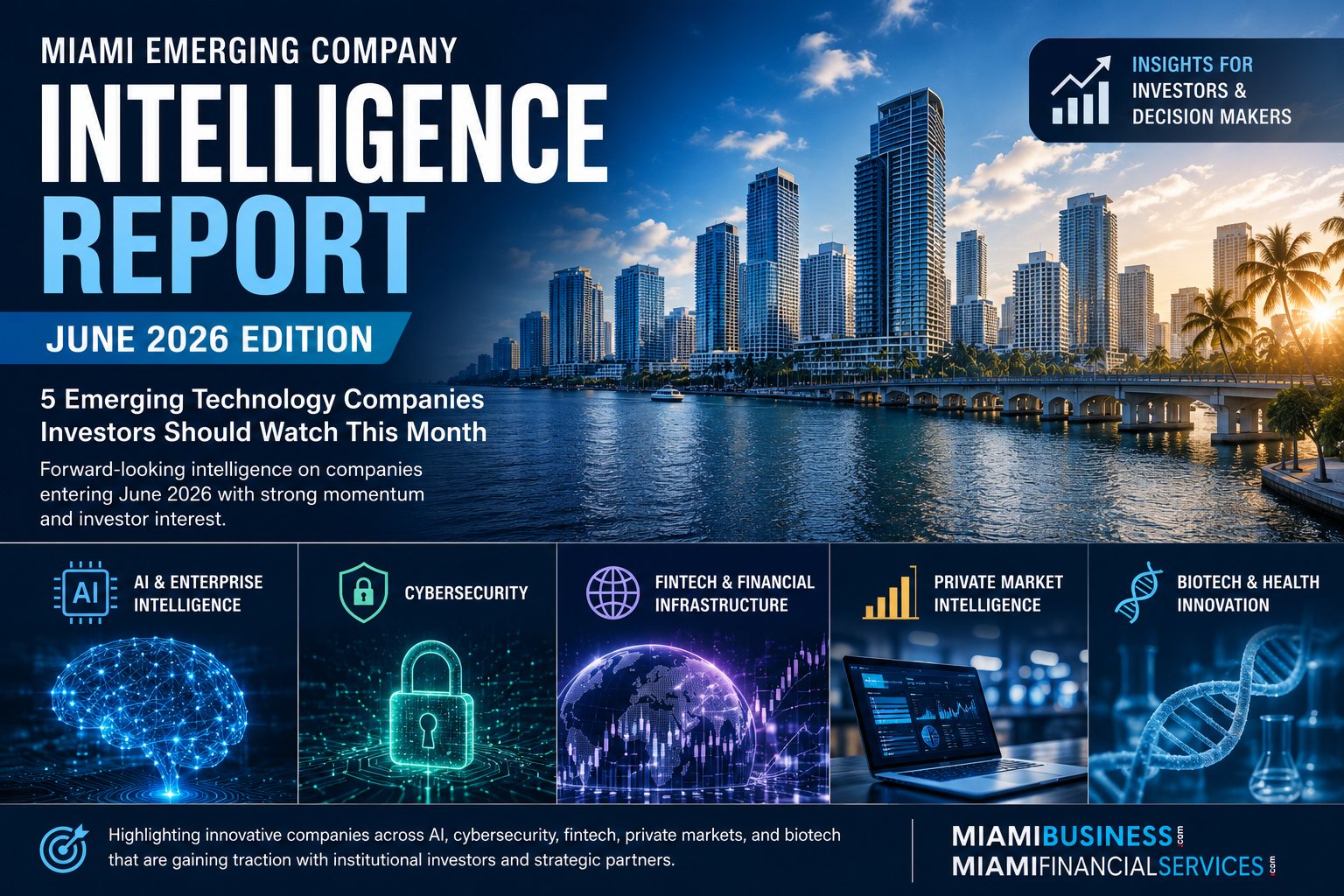
Miami Emerging Company Intelligence Report June 2026

Deal-Flow Intelligence: AI, Cybersecurity, Fintech, Biotech, and Private-Market Intelligence Companies Institutional Investors Are Watching in May 2026
“The infrastructure layer of artificial intelligence continues absorbing capital at a pace that outpaces application-layer investing. The five companies profiled below represent that trend in action.”— MB – Editor.
MiamiBusiness.com | MiamiFinancialServices.com | May 2026 Report | Published June 2026 | Updated November 2026 to provide full May 1–31 retrospective

Reporting Period: May 1–31, 2026
Featured Answer: Five companies—Isomorphic Labs, Elliptic, Pumpkinseed, Corgi Insurance, and Triomics—reported total funding between $380M and $2.1B during May 2026. The aggregate capital signals a market prioritizing infrastructure-scale AI, healthcare data platforms, and vertically integrated fintech over consumer applications. Investors favor companies with existing enterprise revenue, regulatory alignment, and defensible data moats.
TL;DR — Key Takeaways

Isomorphic Labs closed a $2.1 billion Series B on May 12, the largest biotech-related round reported in May 2026.
Elliptic raised $120 million in a Series D on May 12, expanding its AI-driven financial crime detection platform.
Pumpkinseed secured $20 million in Series A funding on May 5 to advance its biological data interpretation infrastructure.
Corgi Insurance announced a $160 million Series B on May 6 to scale its full-stack, AI-powered insurance platform into new verticals.
Triomics raised $22 million in Series B on May 28, extending its cancer data intelligence platform into leading oncology centers.

Target Audience: Institutional investors, venture capitalists, private equity analysts, corporate development teams, and financial professionals tracking emerging technology deal flow in artificial intelligence, cybersecurity, fintech, biotech, and healthcare data intelligence.

Table of Contents
[Click each link to jump to the corresponding section:]

1. Isomorphic Labs — $2.1B Series B (May 12, 2026)
2. Elliptic — $120M Series D (May 12, 2026)
3. Pumpkinseed — $20M Series A (May 5, 2026)
4. Corgi Insurance — $160M Series B (May 6, 2026)
5. Triomics — $22M Series B (May 28, 2026)
Market Observation
Looking Ahead
Frequently Asked Questions
Call to Action
Editorial & Investment Disclaimer

Introduction: Why This Month Matters
May 2026 reinforced a decisive shift in institutional capital allocation. The aggregate funding across the five companies profiled here exceeds $2.4 billion, underscoring that investors are deploying capital at scale into companies building the foundational infrastructure that supports enterprise artificial intelligence, healthcare data, financial crime prevention, and insurance technology. Rather than chasing consumer applications or speculative use cases, capital is flowing into companies that can demonstrate enterprise-grade deployments, regulatory readiness, recurring revenue models, and defensible data moats.
This edition of the Miami Emerging Company Intelligence Report highlights five real companies that entered May 2026 with significant publicly reported funding activity, product development milestones, or commercial expansion. Each company has been evaluated based on publicly available data, and editorial commentary represents independent analysis, not company affiliation.
These companies are presented for informational and editorial purposes only and should not be interpreted as investment recommendations.

1. Isomorphic Labs
Industry: AI-Driven Drug Discovery / Biotechnology Technology
Headquarters: London, United Kingdom (with U.S. operations in Boston, Massachusetts)
CEO: Mohammad Haghverdi (Chief Executive Officer) & Demis Hassabis (Co-Founder and CEO, parent company Alphabet via DeepMind)
LinkedIn: https://www.linkedin.com/company/isomorphic-labs
Website: https://www.isomorphiclabs.com — [Primary funding announcement: https://www.isomorphiclabs.com/press/isomorphic-labs-funding]
Public Phone: Not publicly available
Public Email: Not publicly available
Primary Funding Source: Isomorphic Labs Funding Announcement (May 12, 2026)
Funding Amount: $2.1 billion Series B
Funding Date: May 12, 2026
Investors: Co-invested by GV (Google Ventures), Google, and other institutional investors.
What They Do
Isomorphic Labs is an Alphabet subsidiary company that uses artificial intelligence and deep learning to accelerate drug discovery. Building on technology originally developed within DeepMind, Isomorphic applies transformer models and advanced machine learning to molecular representation, protein structure prediction, and generative chemistry. The company designs novel small-molecule drugs and biological therapeutics for conditions with significant unmet medical need, integrating computational discovery with wet-lab validation pipelines.
Mission
To transform drug discovery through AI, dramatically reducing the time and cost required to bring life-changing medicines to patients.
What They Appear To Be Seeking

Strategic pharma and biotech partnerships for clinical-stage pipelines
Talent acquisition across computational biology, machine learning engineering, and medicinal chemistry
Regulatory engagement and pathway development
Clinical trial execution and patient recruitment infrastructure

Deployment and Commercial Strategy
Isomorphic operates a fully integrated pipeline from target identification through preclinical candidate selection. Its AI-driven discovery engine has been validated against internal and external benchmarking datasets. The company is in active discussions with major pharmaceutical partners to co-develop and commercialize compounds that have progressed into preclinical and early clinical stages. The deployment model emphasizes a dual strategy: advancing internal programs while licensing externally discovered targets into partnered programs.
Financing and Capital Allocation
The $2.1 billion Series B round announced on May 12, 2026, represents one of the largest single-round investments in AI-driven drug discovery. Capital will be directed toward advancing its multi-disease pipeline, expanding its computational infrastructure, hiring across its scientific and engineering divisions, and accelerating clinical development programs. The financing also signals institutional confidence in Isomorphic’s ability to translate AI-generated drug candidates into clinically validated therapies—a transition that historically defines the difference between a technology company and a pharmaceutical company.
Why Investors Are Watching — Editorial Interpretation
Isomorphic’s round is not merely a biotech raise; it is a validation of the thesis that artificial intelligence is becoming an indispensable layer in pharmaceutical R&D. At $2.1 billion, the round establishes Isomorphic among the best-capitalized AI-drug-discovery companies globally. The strategic imperative for pharmaceutical partners is clear: companies that integrate AI-driven discovery into their pipelines gain a structural advantage in speed-to-IND and cost-per-candidate. Investors are watching because the commercial question is no longer whether AI belongs in drug discovery, but which companies can execute at scale, de-risk clinical programs, and generate revenue from AI-discovered assets within a five- to seven-year horizon. Isomorphic’s Alphabet backing provides both capital depth and technological credibility, but the real test will be clinical readouts from partnered programs over the next two fiscal years.

2. Elliptic
Industry: AI-Powered Financial Crime Detection / Cybersecurity / Financial Intelligence
Headquarters: London, United Kingdom
CEO: David Corfield (Co-Founder & CEO)
LinkedIn: https://www.linkedin.com/company/elliptic
Website: https://www.elliptic.co — [Primary funding announcement: https://www.elliptic.co/newsroom/elliptic-secures-120-million-investment]
Public Phone: Not publicly available
Public Email: Not publicly available
Primary Funding Source: Elliptic Secures $120 Million Investment (May 12, 2026)
Funding Amount: $120 million Series D
Funding Date: May 12, 2026
What They Do
Elliptic is a financial intelligence and cybersecurity company that provides AI-powered platforms for detecting, investigating, and preventing financial crime. Its technology analyzes blockchain transaction data, traditional financial flows, and associated metadata to identify illicit activity—including money laundering, sanctions evasion, terrorist financing, fraud, and cyber-enabled financial crime. Elliptic’s platform is used by banks, regulated exchanges, law enforcement agencies, and governments worldwide.
Mission
To fight financial crime at scale using artificial intelligence, making illicit activity impossible to hide.
What They Appear To Be Seeking

Enterprise customers across banking, virtual asset exchanges, and government agencies
Strategic partnerships with global financial institutions and regulators
Expansion of AI model capabilities across emerging crime typologies
International market penetration, particularly in North America and Asia-Pacific

Deployment and Commercial Strategy
Elliptic deploys its platform as a cloud-based solution with on-premise options for highly regulated financial institutions. The company’s graph-based analytics engine processes millions of transactions daily, providing real-time risk scoring and investigation workflows. Enterprise deployment is typically accompanied by managed services, including dedicated analyst support and integration with existing compliance systems such as case management platforms and regulatory reporting tools.
Financing and Capital Allocation
The $120 million Series D announced on May 12, 2026, positions Elliptic among the best-funded companies in the financial intelligence and AML technology sector. Capital will support product development in AI-driven investigation automation, expansion into new vertical markets, hiring of senior technical and commercial talent, and international growth, particularly in markets where regulatory requirements for financial crime prevention are accelerating.
Why Investors Are Watching — Editorial Interpretation
Financial crime regulation has become one of the most consistent growth drivers for compliance technology companies. Regulatory bodies in the EU, United States, and Asia are imposing increasingly stringent requirements on institutions to monitor transaction flows, including cryptocurrency transactions. Elliptic’s combination of blockchain analytics and traditional financial crime detection creates a cross-asset intelligence platform that is difficult to replicate. The $120 million round signals that institutional investors view financial crime prevention as a secular growth market rather than a cyclical compliance expense. The key investment question is whether Elliptic can sustain its competitive moat as traditional banks build internal capabilities and as new entrants target niche segments of the financial crime intelligence market.

3. Pumpkinseed
Industry: Biological Data Infrastructure / Computational Biology / Biotechnology Technology
Headquarters: Boston, Massachusetts
CEO: Not publicly disclosed at this time
Website: https://www.pumpkinseed.bio — [Primary funding announcement: https://www.pumpkinseed.bio/news/pumpkinseed-raises-20m-series-a-to-unlock-biologys-most-valuable-hidden-data-layer]
Public Phone: Not publicly available
Public Email: Not publicly available
Primary Funding Source: Pumpkinseed Raises $20M Series A (May 5, 2026)
Funding Amount: $20 million Series A
Funding Date: May 5, 2026
What They Do
Pumpkinseed is building computational infrastructure designed to extract interpretable biological insights from complex, multi-modal biological datasets. The company’s platform focuses on transforming raw biological data—including genomics, proteomics, and cellular imaging—into structured, actionable knowledge that can be integrated into drug discovery pipelines, precision medicine programs, and biological research workflows. Pumpkinseed’s approach centers on creating standardized data layers that connect disparate biological measurement systems.
Mission
To unlock biology’s most valuable hidden data layer by building infrastructure that makes complex biological information interpretable and actionable.
What They Appear To Be Seeking

Research partnerships with pharmaceutical and biotech organizations
Integration into drug discovery and precision medicine platforms
Talent in computational biology, data engineering, and machine learning
Expansion of data platform capabilities

Deployment and Commercial Strategy
Pumpkinseed’s platform is designed to integrate with existing computational biology workflows used by research institutions, pharmaceutical companies, and biotech organizations. The deployment model is typically cloud-hosted, with data integration pipelines that connect to laboratory information management systems and research databases. Commercial engagement begins with pilot programs that validate the platform’s ability to produce interpretable outputs from specific biological datasets.
Financing and Capital Allocation
The $20 million Series A announced on May 5, 2026, will fund platform development, scientific team expansion, commercial pilot programs, and infrastructure scaling. As a Series A round, it signals institutional confidence in Pumpkinseed’s initial market traction and technical approach, providing the capital runway needed to transition from early-stage platform development to commercial deployment at scale.
Why Investors Are Watching — Editorial Interpretation
The biological data infrastructure market is emerging as a critical enabling layer for the next generation of drug discovery and precision medicine. Companies that can standardize, interpret, and operationalize complex biological data create value that compounds across the entire research ecosystem. Pumpkinseed’s positioning at the data layer rather than the application layer makes it a platform play rather than a point solution. Investors are watching because successful biological data infrastructure companies can achieve broad market penetration across multiple therapeutic areas and customer segments, creating network effects as more research organizations contribute to and draw from the platform. The $20 million round is modest compared to Isomorphic’s $2.1 billion, but it reflects the appropriate capitalization strategy for an early-stage platform company.

4. Corgi Insurance
Industry: AI-Powered Insurance Technology / Fintech
Headquarters: Chicago, Illinois (with technology teams in San Francisco and London)
CEO: Not publicly disclosed at this time
Website: https://www.corgi.com — [Primary funding announcement: https://www.prnewswire.com/news-releases/corgi-raises-160-million-series-b-to-continue-expanding-its-full-stack-insurance-platform-into-new-verticals-302764003.html]
Public Phone: Not publicly available
Public Email: Not publicly available
Primary Funding Source: Corgi Raises $160 Million Series B (May 6, 2026)
Funding Amount: $160 million Series B
Funding Date: May 6, 2026
What They Do
Corgi Insurance is a vertically integrated, AI-powered insurance platform that provides full-stack insurance solutions across multiple product lines and market segments. The company uses artificial intelligence and machine learning to underwrite risk, price policies dynamically, detect fraud, and optimize claims processing. Corgi’s platform enables both direct-to-consumer insurance products and B2B white-label insurance technology services for partner organizations.
Mission
To modernize insurance through technology, making coverage more accessible, affordable, and efficiently delivered through AI-driven processes.
What They Appear To Be Seeking

Market expansion into additional insurance verticals and geographies
Strategic distribution partnerships
Regulatory licensing across additional jurisdictions
Technology platform expansion and AI capability development

Deployment and Commercial Strategy
Corgi operates both as an insurance carrier and as a technology provider. Its full-stack platform allows the company to underwrite policies directly while also licensing its technology to other organizations seeking to offer insurance products. The deployment model combines proprietary underwriting engines, AI-driven pricing models, automated claims processing, and digital customer acquisition channels. Expansion into new verticals requires regulatory approval in each jurisdiction, which drives the need for substantial capital to support licensing, compliance, and actuarial development.
Financing and Capital Allocation
The $160 million Series B announced on May 6, 2026, provides capital for vertical expansion, regulatory licensing, technology development, and operational scaling. Insurance is a capital-intensive industry, and the round positions Corgi to fund the actuarial reserves, compliance infrastructure, and technology investment required to enter new product categories and markets.
Why Investors Are Watching — Editorial Interpretation
The insurance technology sector continues to attract institutional capital as companies demonstrate that AI can materially improve underwriting accuracy, reduce operational costs, and expand distribution reach. Corgi’s full-stack approach—combining carrier operations with technology licensing—creates multiple revenue streams and diversifies risk. The $160 million round reflects investor confidence in Corgi’s ability to scale across insurance verticals, where each new vertical represents both a significant revenue opportunity and a regulatory hurdle that creates barriers to entry for competitors. Investors are watching to see whether Corgi can replicate its success across multiple insurance categories while maintaining underwriting discipline and profitability.

5. Triomics
Industry: Cancer Data Intelligence / Healthcare AI / Health Technology
Headquarters: Not publicly disclosed at this time
CEO: Not publicly disclosed at this time
Website: https://www.triomics.com — [Primary funding announcement: https://www.prnewswire.com/news-releases/trusted-by-leading-cancer-centers-to-solve-oncologys-information-overload-triomics-raises-22-million-to-accelerate-adoption-302784470.html]
Public Phone: Not publicly available
Public Email: Not publicly available
Primary Funding Source: Triomics Raises $22 Million to Accelerate Adoption (May 28, 2026)
Funding Amount: $22 million Series B
Funding Date: May 28, 2026
What They Do
Triomics builds cancer data intelligence platforms that help healthcare organizations solve oncology’s information overload challenge. The company’s technology integrates and analyzes complex cancer data—including genomic sequencing, clinical records, imaging data, and treatment outcomes—to generate actionable insights for oncologists, researchers, and healthcare administrators. Triomics’ platform is designed to improve diagnostic accuracy, optimize treatment selection, and support clinical decision-making in cancer care.
Mission
To empower oncology teams with data-driven insights that improve patient outcomes and advance cancer care through intelligent data analysis.
What They Appear To Be Seeking

Expansion into additional cancer centers and healthcare systems
Integration with electronic health record systems and hospital information platforms
Clinical validation studies and publication of outcome data
Talent in oncology, data science, and health informatics

Deployment and Commercial Strategy
Triomics deploys its platform within cancer centers and healthcare systems, integrating with existing clinical workflows and information systems. The company’s go-to-market strategy centers on demonstrating measurable improvements in diagnostic accuracy and treatment optimization through pilot deployments at leading oncology centers. Commercial contracts typically include platform licensing, data integration services, and ongoing analytical support.
Financing and Capital Allocation
The $22 million Series B announced on May 28, 2026, will fund commercial expansion, clinical validation studies, technology development, and strategic hiring. As a Series B round, it indicates that Triomics has achieved meaningful adoption within its target market and is now scaling deployment across additional healthcare institutions.
Why Investors Are Watching — Editorial Interpretation
Healthcare AI companies that deliver measurable clinical value—rather than simply providing data visualization or administrative automation—are among the most resilient investment themes in the current market. Triomics’ focus on cancer data intelligence addresses a genuine clinical need: oncologists must synthesize information from multiple data sources to make treatment decisions, and the volume and complexity of this information continue to grow. Companies that can integrate and interpret this data in real time create a defensible competitive position, particularly when validated by adoption at leading cancer centers. Investors are watching because healthcare AI adoption is driven by clinical evidence, and companies that can demonstrate improved patient outcomes and operational efficiency have a clear path to sustained revenue growth.

Market Observation: The Infrastructure Thesis
May 2026’s funding activity reinforces a structural thesis that has been developing throughout 2026: institutional investors are deploying capital at scale into the infrastructure layer of emerging technologies rather than application-layer companies. The five companies profiled here—spanning AI drug discovery, financial crime detection, biological data infrastructure, insurance technology, and cancer data intelligence—share common characteristics that investors are prioritizing in 2026.

Enterprise revenue potential: Each company targets large institutional customers or regulated industries with substantial budgets
Data moats: Each platform generates or processes proprietary data that becomes more valuable as usage scales
Regulatory alignment: Each company operates in a sector where regulatory requirements drive technology adoption
AI integration: Each company uses artificial intelligence as a core component of its product, not as a marketing differentiator

This pattern is unlikely to reverse in the near term. Regulatory pressures, data complexity, and the proven effectiveness of AI in enterprise workflows create sustained demand for the types of platforms these companies are building.

Looking Ahead
As the market continues evolving through the remainder of 2026, investors should monitor the following developments closely:

Clinical trial readouts from AI-discovered drug candidates
Regulatory changes affecting financial crime reporting requirements
Adoption metrics for biological data infrastructure platforms
Insurance regulatory approvals for new product categories
Clinical validation studies from cancer data intelligence companies
Ongoing consolidation in the AI infrastructure investment landscape
Geopolitical developments affecting technology investment flows

Future editions of the Miami Emerging Company Intelligence Report will continue highlighting companies demonstrating meaningful commercial traction, technological innovation, and institutional relevance.

Frequently Asked Questions
Q: Why are these companies grouped together in a single report?
A: The companies were selected because they each reported significant publicly reported funding activity or strategic milestones during May 2026. They are grouped together because they share a common investment thesis: institutional capital is increasingly flowing into infrastructure-layer technology companies that serve enterprise and regulated industry customers, rather than consumer applications. Each company was evaluated independently based on publicly available data.
Q: Is Isomorphic Labs part of Alphabet?
A: Yes. Isomorphic Labs is a subsidiary of Alphabet Inc., the parent company of Google and DeepMind. The $2.1 billion Series B was co-invested by GV (Google Ventures) and other institutional investors alongside Alphabet.
Q: How does Elliptic’s technology differ from traditional AML platforms?
A: Elliptic combines blockchain transaction analysis with traditional financial crime detection capabilities, providing cross-asset intelligence that covers both cryptocurrency and fiat transactions. Its AI-driven graph analytics engine processes transaction data in real time, providing risk scoring and investigation workflows that are specifically designed for the scale and complexity of modern financial crime networks.
Q: Are these companies investment recommendations?
A: No. These companies are presented for informational and editorial purposes only. Inclusion in this report does not constitute an investment recommendation, endorsement, or prediction of future performance. Readers should conduct their own due diligence and consult qualified financial professionals before making investment decisions.
Q: What is the significance of the May 2026 reporting period?
A: The May 2026 reporting period captures companies that entered the month with significant publicly reported funding activity, product development milestones, or commercial expansion. The aggregate funding across the five companies—exceeding $2.4 billion—reflects institutional investor priorities and capital allocation trends during this specific timeframe.

Call to Action
Stay informed on emerging company deal flow. The Miami Emerging Company Intelligence Report is published monthly, highlighting companies demonstrating meaningful commercial traction, technological innovation, and institutional relevance. Subscribe to MiamiBusiness.com and MiamiFinancialServices.com for monthly updates on emerging technology deal flow, institutional investment trends, and enterprise technology company profiles.

Editorial & Investment Disclaimer
The information published by MiamiBusiness.com and MiamiFinancialServices.com is provided solely for informational, educational, and journalistic purposes.
Nothing contained in this publication constitutes investment advice, financial advice, legal advice, tax advice, accounting advice, securities recommendations, or a solicitation to buy, sell, or invest in any security, company, private placement, venture capital fund, private equity fund, cryptocurrency, or other financial instrument.
Companies discussed have been selected based on publicly available information and editorial judgment. Inclusion does not constitute an endorsement, recommendation, ranking, or prediction of future performance.
MiamiBusiness.com, MiamiFinancialServices.com, Wilson Alvarez Consulting Group, Inc., and their affiliates are not registered investment advisers or broker-dealers. Readers should perform their own due diligence and consult qualified financial, legal, tax, and accounting professionals before making investment or business decisions.
Information may change without notice, and no warranty is made regarding its completeness or accuracy. All trademarks and company names remain the property of their respective owners and are used solely for editorial identification.
Published by MB – Editor. | MiamiBusiness.com | Wilson Alvarez Consulting Group, Inc. | All Rights Reserved

Read More

Setting Business Goals—and Following Through

“A business goal earns its value when it becomes a clear commitment, a practical plan and a regular review.”

“Don’t become a wandering generality. Be a meaningful specific.”

— Zig Ziglar (Ziglar’s official quote collection)
TL;DR: Effective business goals connect a meaningful outcome to a clear measure, an owner, a deadline and regular review. Choose a few priorities, break them into near-term actions, track leading indicators as well as results, and adjust when new evidence appears. A useful plan creates focus without pretending that every forecast will be exact.
Direct answer: To set business goals and follow through, identify the most important result for the next quarter or year, define how you will measure it, assign responsibility, list the first actions and review progress on a fixed schedule. Keep the number of goals small enough for your team to execute while maintaining daily operations.
Entrepreneurs often have more ideas than available hours. A new service, a marketing campaign, a hiring plan and an operational improvement can all sound urgent. Without a process to decide what matters most, the calendar fills up while the most important work keeps moving to next week.
Business goals create a shared direction. They help the owner decide where to focus, explain priorities to employees and notice when circumstances require a change. The strongest goals are ambitious enough to matter and specific enough to guide what people do next.
Start with the outcome that matters
Begin by asking what must be different when this goal is achieved. “Grow the business” is too broad to guide choices. “Increase recurring revenue from existing customers by 12% by December” gives the team a result it can measure and discuss. The measure should reflect something the business genuinely values, not a number selected merely because it is easy to count.
Choose goals that support the company’s current stage and strategy. A new business may need to validate demand and establish reliable delivery. A mature company may need to improve retention, strengthen margins or develop new leaders. A goal that sounds impressive can still be a poor fit if the organization lacks the capacity or evidence to pursue it responsibly.
Limit the number of priorities
A long list of goals can create the appearance of ambition while diluting attention. Pick a few that the business can realistically advance alongside its essential work. If every initiative is a top priority, employees may not know what to protect when deadlines collide. Ask which one or two outcomes would make the biggest difference and which projects can wait.
Do not confuse choosing priorities with ignoring other responsibilities. Customer service, payroll, compliance and quality still need consistent attention. The point is to identify the improvements that deserve focused effort and make sure the team has time and resources to deliver them.
Turn each goal into actions and ownership
For every target, list the actions that can move it forward. A goal to improve repeat business might require reviewing customer feedback, identifying drop-off points, testing a follow-up process and training staff. Assign one person to coordinate the work, even when several people contribute. Shared responsibility without a clear owner can make progress difficult to see.
Break annual outcomes into shorter checkpoints. Quarterly milestones can show whether a strategy is working early enough to make changes. Weekly actions help employees know what to do now. Define what is within each person’s control and provide the tools or authority needed to act.
Track leading and lagging indicators
Revenue, profit and customer retention are important outcomes, but they often arrive after the activities that influence them. Leading indicators help the team see whether it is doing the work that may produce future results. Depending on the goal, these could include qualified sales conversations, proposals delivered, appointments kept, product defects resolved or customer follow-ups completed.
Use a small, reliable set of measures. A dashboard with dozens of numbers can obscure the signal. For each goal, agree on the target, the data source and how often it will be updated. If different departments calculate the measure differently, the team may spend review meetings debating the number instead of addressing the work.
Create a regular review rhythm
Goals need attention after the planning meeting ends. Schedule brief weekly check-ins for execution and a deeper monthly or quarterly review for results and assumptions. Ask: What moved forward? What is blocked? What have we learned? What will happen next, who owns it and by when?
The U.S. Small Business Administration describes planning as a recurring management process that can include tracking milestones, performance measures and essential financial projections. Its guidance recommends regular review and adjustment as a business moves toward its goals (SBA on lean business planning). Reviews are useful when they lead to decisions, not just status reports.
Make accountability constructive
Accountability should clarify commitments and help people solve obstacles. It works poorly when every missed target becomes a search for blame. If progress is behind, look at the facts: Was the goal unrealistic? Did a customer or supplier change the situation? Were priorities unclear? Did the team lack a decision or resource? Then agree on a correction and a new checkpoint.
Leaders should be accountable too. If the owner changes direction, delays a needed decision or fails to provide promised support, acknowledge it openly. Employees are more likely to report problems early when they see that honest updates lead to problem-solving rather than punishment.
Adjust goals when evidence changes
Commitment does not require stubbornly following a plan that has stopped making sense. Market conditions, customer behavior, costs and regulations can shift. Review whether the original assumptions still hold. If they do, the team may need a better execution plan. If they do not, update the target or strategy and explain why.
Keep a record of changes: what new information appeared, what decision was made and when progress will be checked again. This creates continuity and helps the team understand that adjustment is part of responsible management, not a sudden loss of direction.
Recognize progress and learn from misses
Celebrating progress reinforces useful habits. Recognition does not need to be expensive; a specific thank-you or a short recap of what the team accomplished can show that the work matters. When a goal is missed, take the opportunity to understand the gap. The lesson may be about timing, capacity, customer demand, sales process or the original target itself.
Goals are tools for better decisions. They help an owner protect time, coordinate people and put effort behind outcomes that matter. Keep them visible, practical and open to review. Then follow through on the next action, not just the annual ambition.
Frequently asked questions
How many goals should a small business set?
There is no single right number. Start with a small set of high-priority outcomes that the team can track while keeping essential operations running. If people cannot name the priorities, the list may be too long.
How often should business goals be reviewed?
Use brief, regular check-ins to remove execution obstacles and a deeper monthly or quarterly review to assess results and assumptions. Set the rhythm based on the speed and complexity of the work.
What makes a business goal measurable?
A measurable goal states the outcome, the metric, the target and the time period. It also names who will coordinate the work and where progress data will come from.
Should a business change its goals during the year?
Yes, when evidence changes the assumptions behind the plan. Document why the goal changed, communicate the decision and establish a new way to evaluate progress.
How Wilson Alvarez Helps Business Owners
Wilson Alvarez works with entrepreneurs and business owners on strategy, digital visibility and practical business challenges. To discuss a question affecting your company, call 305-266-7883, email info@wilsonalvarez.com or visit WilsonAlvarez.com.
Disclaimer: This article provides general business information and is not legal, tax, accounting, financial or individualized professional advice. Consult qualified professionals about decisions specific to your business.
About the Author: Wilson Alvarez is an entrepreneur, consultant and business owner who writes about entrepreneurship, leadership, marketing and business growth for MiamiBusiness.com.

Read More

State of Medley: June 2026

At a glance: Medley June 2026 honored local police professionals and put practical safety concerns on the Council agenda, including fire service coordination, road work and flooding along South River Drive.
Recognizing the people who serve
At its June 1 meeting, the Town Council agenda listed awards for Police Officer of the Year, Civilian Employee of the Year, Community Impact, a major arrest, and the Police Explorers. Recognition is a small but meaningful way to thank officers and civilian staff whose work often happens quietly and under pressure.
The Town has its own Police Department. Fire and EMS service comes from Miami-Dade County. The June agenda listed a county fire service consent agreement for property at 7777 NW 72nd Avenue, along with related security system and fire alarm agreements. Agenda listings show what was presented for consideration; the minutes provide the official result.
Infrastructure protects daily life
Other June agenda items included a water distribution audit, road paving and resurfacing, and a Council request to discuss flooding on South River Drive. Flooding is more than a map concern. It affects commutes, business deliveries and the ability of first responders to move safely.
Families can also make use of Town recreation and youth opportunities, including soccer registration and a Sports Contribution Grant. Availability and eligibility may change, so check the Town’s current Social Services notices before applying.
Frequently asked questions
Who provides Medley fire service?
Miami-Dade Fire Rescue provides county fire and EMS service; the Town’s agenda records related service agreements.
What flooding issue was raised in June?
A Council request on the June agenda asked to discuss South River Drive flooding.
Sources: June 1 Council agenda and records; Medley Social Services and recreation programs; Miami-Dade Fire Rescue.

Read More