
Select Page

Communities

Widgetized Area

This panel is active and ready for you to add some widgets via the WP Admin

North Bay Village, Florida, offers a selection of accommodations to suit various preferences and budgets. Here are some hotels in and around the area:

North Bay Village, FL

A midscale, smoke-free hotel featuring a heated outdoor swimming pool, exercise room, and on-site restaurant and lounge. Conveniently located 12 miles from Miami Airport.

North Bay Village, FL

A clean and safe accommodation option with street parking, located 20 minutes from Miami. Guests appreciate its convenient location and friendly staff.

North Bay Village, FL

Offers spacious apartments with excellent views of Biscayne Bay, easy parking, and a well-equipped kitchen. Ideal for families and longer stays.

North Bay Village, FL

Provides large rooms with comfortable accommodations, including kitchen facilities. Guests enjoy the home-like atmosphere and good cleaning service.

North Bay Village, FL

Offers budget-friendly accommodations with basic amenities. Some guests have noted areas for improvement in cleanliness and maintenance.

These options provide a range of amenities and price points to cater to different traveler needs in North Bay Village.

A Homeowner’s Guide to Property Damage in Condominiums and HOAs in Florida


A Homeowner’s Guide to Property Damage in Condominiums and HOAs in Florida

Provided by Perez Mayoral, P.A. – Florida attorneys representing homeowners and condo owners in disputes with their associations
If you own a condominium unit or a home in an HOA community in Florida, you’ve probably heard conflicting information when property damage occurs:

“That’s inside your unit, so it’s your problem.”
“You need to file a claim with your own insurance.”
“We fixed the leak—the rest is on you.”

The reality is more complicated—and often more favorable to you than you’ve been led to believe.
Florida law imposes clear statutory and contractual duties on associations to maintain common elements and shared infrastructure. When they fail to do so, associations can be held responsible for the resulting damage inside your home, including repairs, mold remediation, and even your costs for temporary housing.
This guide explains your rights, what the law actually says, and what you should do when damage happens.
Why Property Damage Disputes Are So Common
Condominiums and HOAs rely on shared infrastructure that serves multiple homes:

Roofs and exterior walls
Plumbing and sewer lines serving more than one unit
Structural slabs, beams, and columns
Balconies and building envelopes
Drainage systems

When something goes wrong with these shared components, three different parties often focus on three different questions:

You focus on the damage inside your home and what it will cost to fix.
The association focuses on whether insurance will cover it and who’s going to pay.
The law focuses on who had the legal duty to maintain the component that failed—and whether they breached that duty.

The Law Is Clear: Associations Have Nondelegable Repair Duties
In Condominiums
Florida’s Condominium Act is unambiguous:
The association is responsible for maintenance of the common elements.Section 718.113(1), Florida Statutes
“Common elements” means all portions of the condominium property not included in the units—which typically includes everything between the unfinished surfaces of your walls, floor, and ceiling.
This duty is nondelegable. That means:

The association can’t avoid it by blaming a contractor.
The association can’t avoid it by saying a unit owner caused the problem.
The association can’t avoid it by pointing to its insurance carrier.

The McLlenan Case: A Landmark Decision
In McLlenan v. Cypress Chase North Condominium No. 4 Association, Inc., Florida’s Fourth District Court of Appeal made this perfectly clear:

A leak from an upstairs unit caused water and sewage damage in the downstairs unit.
The association tried to argue it wasn’t responsible because the leak came from a unit.
The court said the association had a duty to repair the common elements (the space between floors) regardless of the cause.
The association could later seek reimbursement from the negligent upstairs owner, but it could not refuse to make the repairs.

Key takeaway: Even if another unit owner caused the problem, the association must still repair the common elements and address the resulting damage. Their remedy is to go after that owner later—not to leave you stuck with the bill.
In HOAs
Homeowners associations are governed primarily by their recorded declarations and covenants, not the Condominium Act. But many HOA declarations still impose maintenance duties on the association for:

Roofs
Exterior walls and siding
Shared drainage or utility systems
Structural components in townhouse or villa-style communities

If your HOA declaration says the association is responsible for maintaining something, that’s a binding contract. When the association breaches that duty and damage results, you can hold them accountable.
What Happens When the Association Hires a Contractor?
Many associations assume they’re off the hook if they hire a contractor to do repairs. That’s not true when a nondelegable duty exists.
The Walters Case: Associations Can’t Hide Behind Contractors
In Walters v. Beach Club Villas Condominium, Inc., a contractor working on a common-area dock caused an injury. The association tried to argue it wasn’t liable because an independent contractor did the work.
Florida’s Third District Court of Appeal disagreed:

The association had a nondelegable duty to maintain the dock under both statute and its declaration.
Because of that duty, the association was held jointly and severally liable for the contractor’s negligence.

What this means for property damage:
If the association hires a contractor who:

Over-demolishes your unit
Fails to properly remediate mold
Causes additional water damage during repairs

The association can still be held responsible because its duty to maintain and repair common elements is nondelegable.
Common Types of Property Damage Claims

Water Intrusion and Plumbing Failures

This is the most frequent source of disputes:

Roof leaks
Failed waterproofing on exterior walls
Burst pipes serving multiple units
Sewer line backups or failures
Recurring drainage problems

These events routinely damage drywall, flooring, cabinetry, electrical systems, and personal belongings.

Structural and Building Envelope Problems

Cracked slabs, deteriorating concrete, failing balconies, and compromised exterior walls are typically common elements. When associations delay necessary repairs after being notified, the resulting interior water intrusion can form the basis for multiple legal claims: negligence, breach of contract, and statutory violations.

Mold and Environmental Damage

Mold almost always signals prolonged moisture and inadequate or delayed remediation. It can make your home temporarily uninhabitable and cause serious health issues.
Interior finishes—your flooring, cabinets, baseboards, paint—are often damaged twice:

First by the water event itself
Again by overly aggressive demolition during poorly supervised association repairs

Loss of Use and Displacement Costs

When your home becomes unsafe or uninhabitable, you may incur:

Hotel or temporary housing costs
Moving and storage expenses
Lost rental income if you lease the property

These “loss of use” damages are recoverable when they flow naturally from the association’s breach of duty.
Insurance Does Not Decide Who’s Legally Responsible
Here’s a critical point many associations get wrong:
Insurance is a funding mechanism. It does not determine legal duties.

The association’s statutory duty under Florida law exists whether or not its insurance carrier accepts the claim.
The association’s contractual duty under the declaration exists whether or not a deductible applies.
Hiring a contractor or relying on an insurance company’s position does not eliminate the association’s liability when a nondelegable duty exists.

Section 718.113(1) of the Florida Statutes contains no exception that relieves the association of its maintenance duty when damage was caused by an individual unit owner. The association must still repair—it can seek reimbursement later.
Recurring Damage Changes Everything
If you’ve experienced the same problem multiple times—repeated leaks, ongoing moisture, recurring backups—that dramatically strengthens your legal position.
Recurrence establishes:

The association had prior notice of a defective condition
The association failed to adequately investigate the root cause
The association failed to implement a permanent fix

In McLlenan, the unit experienced multiple leaks over several months. The association initially did little, then performed only partial remediation—tearing out the kitchen but failing to properly address mold that had spread throughout the unit.
Patterns of recurring damage support:

Negligence claims (the association knew and failed to act)
Expanded consequential damages (additional mold growth, extended uninhabitability)

Your Governing Documents Matter—But They’re Not a Shield
Your condominium declaration or HOA covenants allocate maintenance responsibilities, but they do not permit associations to ignore known problems or refuse to repair common elements.
Associations often cite provisions stating that owners are responsible for interior finishes (walls, flooring, cabinets) as a complete defense.
That argument frequently fails when you can prove that your interior damages were caused by the association’s failure to maintain or timely repair components under its control.
Under Florida law, when an association breaches its maintenance duty, it can be liable for foreseeable consequential damages—including damage inside your unit and loss-of-use costs.
What You Should Do When Damage Occurs
Protect yourself and preserve your legal rights by taking these steps immediately:

Document Everything

Take clear photos and videos of the damage, the suspected source, visible mold, and staining
Repeat documentation after each new event or repair attempt
Create a timeline of when each incident occurred

Provide Written Notice

Report the issue in writing to both management and the board (email and certified mail if appropriate)
Describe the problem, dates of occurrence, and any health or habitability concerns
Keep copies of everything

Request Information

Ask whether the association has filed a claim with its master insurance carrier
Request the claim number, adjuster contact information, and any written reports
Ask for copies of any remediation protocols or contractor proposals

Track All Expenses

Keep receipts for:

Emergency repairs
Temporary housing and meals
Moving and storage costs
Cleaning and laundry
Medical visits related to mold or environmental exposure
Lost rental income

These can all become part of your damages claim.

Be Cautious with Documents

Do not sign:

Broad liability releases
Waivers of future claims
“Settlement” agreements tied to partial repairs or limited reimbursements

Get legal review first, especially when recurring or structural problems exist.
Key Legal Takeaways for Florida Owners

Interior damage is not automatically your responsibility. When it’s caused or worsened by the association’s failure to maintain common elements, the association can be liable.
In condominiums, the association has a statutory, nondelegable duty to maintain common elements under section 718.113(1), Florida Statutes. Court decisions like Walters and McLlenan reinforce this.
The cause of damage doesn’t relieve the association’s repair duty. Even if a negligent unit owner caused the problem, the association must still repair the common elements. It can seek reimbursement later.
Hiring a contractor doesn’t break the chain of responsibility. When a nondelegable duty exists, the association can be held liable for the contractor’s negligence.
Recurring damage and delayed repairs strengthen your claim by establishing notice, pattern, and foreseeability of greater harm.
Documentation and written notice are critical. They preserve your legal rights and counter improper denials or attempts to shift all responsibility onto you.

Need Help?
If you’re dealing with property damage in a condominium or HOA-governed home and have questions about your rights and next steps, Perez Mayoral, P.A. can help.
We represent homeowners and condo owners throughout Florida in disputes with their associations, including claims for water damage, mold, structural issues, and association or contractor negligence.
Contact us:
🌐 Website: www.pmlawfla.com📞 Phone: 305-928-1077✉️ Email: info@pmlawfla.com
This guide is for informational purposes and does not constitute legal advice. Every case is different, and you should consult with an attorney about your specific situation.

Read More

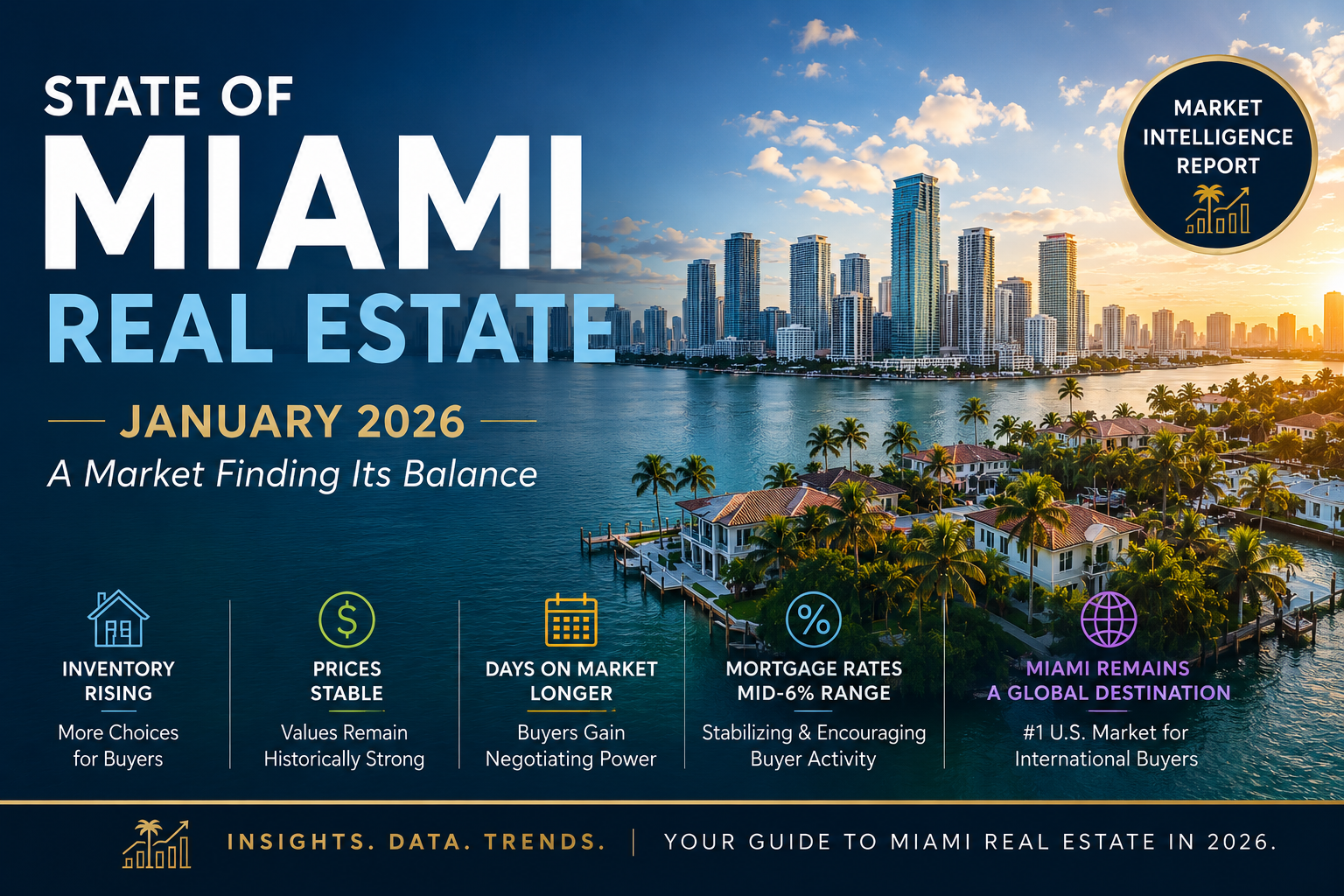
State of Miami Real Estate – January 2026

A Market Finding Its Balance

Inventory expanded, buyers gained negotiating power, and Miami entered 2026 with a healthier—but more selective—real estate market.

Executive Summary
If 2025 was the year Miami’s real estate market began transitioning away from the frenzied pace of the post-pandemic boom, January 2026 marked the beginning of a more balanced chapter.
The market did not weaken—it matured.
Inventory continued to grow across Miami-Dade County, providing buyers with more choices than they had seen in several years. Sellers remained in a favorable position compared to most U.S. markets, but pricing strategy became more important than ever. Homes priced correctly continued to sell, while overpriced listings often lingered on the market.
Perhaps the biggest story wasn’t declining demand—it was changing expectations.
Today’s buyers are more patient, more informed, and more willing to negotiate. Meanwhile, sellers have begun adjusting to a marketplace where presentation, pricing, and preparation once again determine success.
For investors, luxury buyers, and international purchasers, Miami continued to stand apart from nearly every other major U.S. metropolitan area.

Market Snapshot
January delivered encouraging signs that Miami’s housing market is evolving toward long-term sustainability rather than speculative growth.
Single-family homes remained the strongest sector. Median prices continued climbing year-over-year while inventory expanded enough to reduce the intense competition seen over the past several years. Closed sales increased modestly, demonstrating that buyer demand remains healthy despite higher borrowing costs. Miami-Dade’s single-family median sales price reached approximately $699,990, with inventory approaching a balanced six-month supply. (MIAMI REALTORS® + RWorld)
The condominium market told a different story.
Inventory rose significantly, giving buyers considerably more negotiating leverage than they have enjoyed in years. While condo values generally remained stable, sellers increasingly found themselves competing not only on price but also on HOA fees, reserve funding obligations, insurance costs, and building compliance requirements. (Realtor)

Single-Family Homes Continue Leading the Market
Miami’s single-family housing sector continues to demonstrate remarkable resilience.
Demand remains supported by several long-term economic fundamentals:

Continued population growth
Corporate relocations
Limited developable land
High-income domestic migration
Strong local employment

Unlike many metropolitan markets that experienced sharp corrections following the pandemic housing boom, Miami continues benefiting from structural demand drivers that extend well beyond interest rates.
While buyers have become more selective, desirable homes located in established neighborhoods such as Coral Gables, Pinecrest, South Miami, Coconut Grove, and Miami Lakes continue attracting multiple qualified buyers when priced appropriately.
The days of simply placing a sign in the yard and expecting offers above asking price are largely behind us.
Today’s market rewards preparation.

Condominiums Enter a New Phase
No segment better illustrates Miami’s changing market dynamics than condominiums.
Following Florida’s enhanced structural inspection requirements and reserve funding laws enacted after the Surfside tragedy, buyers have become increasingly diligent when evaluating condominium purchases.
Questions that rarely surfaced several years ago have become standard during due diligence.
Buyers now routinely ask:

Has the milestone inspection been completed?
Is the Structural Integrity Reserve Study current?
Are there pending special assessments?
How financially healthy is the association?
What insurance increases should owners expect?

These additional considerations have lengthened transaction timelines while creating more opportunities for educated buyers.
Buildings with strong financial reserves, proactive boards, and transparent management continue outperforming comparable properties lacking those characteristics.

Luxury Real Estate Remains Exceptionally Strong
One area showing little sign of slowing is Miami’s luxury market.
High-net-worth buyers continue viewing South Florida as a desirable destination for wealth preservation, lifestyle, business expansion, and international diversification.
January saw continued strength in million-dollar transactions, reflecting sustained confidence among affluent purchasers. Luxury demand remains driven less by mortgage rates and more by long-term investment objectives and lifestyle preferences. (MIAMI REALTORS® + RWorld)
Ultra-luxury buyers continue targeting waterfront estates, branded residences, and trophy properties throughout:

Fisher Island
Miami Beach
Bal Harbour
Key Biscayne
Coral Gables
Coconut Grove
Pinecrest

For this segment of the market, inventory remains relatively constrained despite broader market normalization.

International Buyers Continue Choosing Miami
Miami’s global appeal remains unmatched.
The city continues attracting buyers from Latin America, Europe, and Canada seeking political stability, business opportunities, favorable tax policies, and an exceptional quality of life.
According to the MIAMI Association of REALTORS®, Miami once again ranked as the No. 1 U.S. destination for international homebuyers, accounting for a substantial share of all foreign residential transactions in Florida. International buyers purchased approximately $4.4 billion in South Florida residential real estate during 2025, with Miami-Dade representing the majority of those sales. (MIAMI REALTORS® + RWorld)
Many of these buyers pay cash, helping insulate portions of Miami’s market from fluctuations in mortgage interest rates.

Mortgage Rates Continue Influencing Buyer Behavior
Although mortgage rates remained elevated compared to the historic lows experienced during 2020 and 2021, many buyers have accepted that today’s financing environment represents the new normal.
Rather than waiting indefinitely for dramatically lower rates, qualified buyers increasingly recognize they can refinance in the future while securing desirable properties today.
This mindset has helped maintain transaction activity despite affordability challenges.
For sellers, it reinforces the importance of realistic pricing and effective marketing.

Commercial Real Estate Shows Continued Momentum
Commercial investment across Miami remained active entering 2026.
Office leasing continued benefiting from financial firms relocating operations to South Florida.
Industrial properties remained in high demand due to logistics, international trade, and e-commerce growth.
Mixed-use developments continued attracting investor interest as developers sought projects combining residential, retail, hospitality, and office components.
While national headlines often focused on office vacancies in other cities, Miami continued distinguishing itself through population growth and corporate expansion.

What Buyers Should Know
January created opportunities that simply did not exist two years ago.
Buyers now enjoy:

More available inventory
Longer decision-making periods
Greater negotiating leverage
Increased seller concessions
Better property selection

That does not necessarily mean prices are falling dramatically.
Instead, buyers have regained something equally valuable:
Options.
The most successful purchasers will continue focusing on long-term value rather than attempting to perfectly time the market.

What Sellers Should Know
The market is still favorable—but expectations must evolve.
Successful sellers in 2026 understand three realities:
Price correctly from day one.
Today’s buyers have more inventory to compare.
Prepare your property.
Professional photography, staging, repairs, and marketing matter more than ever.
Be responsive.
Negotiation has returned to normal real estate transactions.
Properties priced realistically continue selling quickly, while ambitious pricing often results in extended market time followed by price reductions.

Looking Ahead to February 2026
January suggests Miami is entering one of the healthiest market environments seen in several years.
Rather than extreme seller dominance or dramatic buyer advantage, the market is gradually moving toward equilibrium.
That balance benefits everyone.
Buyers gain confidence.
Sellers remain positioned to achieve strong values.
Investors continue finding opportunities.
International capital continues flowing into South Florida.
Most importantly, Miami’s underlying economic fundamentals remain exceptionally strong.
Population growth, global investment, corporate relocation, infrastructure improvements, and limited land availability continue supporting long-term confidence in the region.
As 2026 unfolds, the market will likely reward expertise over speculation, preparation over emotion, and strategy over timing.
For buyers, sellers, and investors alike, that may prove to be the healthiest real estate environment Miami has experienced in years.

Editorial Disclosure
This State of Miami Real Estate – January 2026 report was prepared by MiamiRealEstateNews.com using publicly available information from multiple reliable sources, including the MIAMI Association of REALTORS®, Florida Realtors®, Realtor.com, and other market data providers. Market statistics have been summarized and interpreted for educational and informational purposes. This report does not constitute legal, tax, financial, or investment advice. Readers should consult qualified real estate, legal, tax, or financial professionals before making real estate decisions. (MIAMI REALTORS® + RWorld)

Read More

Attempted Murder Charges in Florida: What Intent Really Means

How prosecutors define intent, why the outcome doesn’t matter, and what defenses can change the direction of your case
“Criminal liability isn’t about what happened—it’s about what the state claims you meant to do.”
— Carolle El-Naffy

TL;DR – In Florida, attempted murder charges hinge on intent, not whether a death occurred. Prosecutors must prove a specific intent to kill and a meaningful step toward carrying it out. Early legal representation is critical to challenge evidence, intent, and overcharging.

How Florida Treats Attempted Murder Charges
An attempted murder allegation in Florida carries consequences nearly as severe as a completed homicide—even when the alleged victim survives. Many people assume the lack of a fatal outcome reduces the seriousness of the charge. However, Florida law centers on what the defendant intended, not what ultimately happened.
As a result, prosecutors frequently pursue attempted murder charges when they believe a person acted with the purpose of killing, regardless of the final outcome. The distinction between attempted murder and a lesser violent offense often determines whether a defendant faces years—or decades—behind bars.

Legal Definition of Attempted Murder in Florida
To secure a conviction for attempted murder, the prosecution must establish all of the following beyond a reasonable doubt:

The accused formed a conscious intent to cause the victim’s death

The accused took a direct action toward carrying out that intent

The conduct progressed beyond planning but did not result in death

If the state cannot prove intent to kill, the charge may not legally stand.
See: Florida Statutes § 777.04 (Criminal Attempt)

Levels of Attempted Murder Under Florida Law
Florida categorizes attempted murder into two primary forms, each carrying serious penalties.
Attempted First-Degree Murder
This charge applies when prosecutors allege either:

A deliberate, premeditated intent to kill, or

Involvement in a qualifying felony during which an attempted killing occurred

Attempted first-degree murder is classified as a first-degree felony and may result in life imprisonment, particularly when firearm enhancement laws apply.

Attempted Second-Degree Murder
Attempted second-degree murder focuses on conduct prosecutors describe as:

Inherently dangerous

Showing extreme disregard for human life

Demonstrating a “depraved mind”

These cases often arise from shootings, stabbings, or violent confrontations where the state argues reckless conduct amounted to lethal intent.

Situations That Commonly Lead to Attempted Murder Allegations
Charges often stem from incidents such as:

Non-fatal shootings

Knife-related assaults

Escalated road-rage encounters

Domestic altercations

Gang-related investigations

In many cases, however, the facts may support lesser charges rather than attempted murder.

Defense Strategies in Attempted Murder Cases
Because intent is central, attempted murder charges are frequently open to challenge. Defense strategies may include:

Arguing the absence of intent to kill

Establishing self-defense or lawful use of force

Seeking reduction to aggravated battery or assault

Exposing weak or circumstantial evidence

Challenging unconstitutional searches or interrogations

Each detail—statements, forensic evidence, witness credibility—can dramatically affect the outcome.

Potential Consequences of a Conviction
A conviction for attempted murder can lead to:

Lengthy prison sentences or life incarceration

Mandatory minimum penalties tied to firearms

A permanent felony record

Loss of civil and firearm rights

Serious employment and immigration repercussions

Given these stakes, early and strategic legal action is essential.

Accused of Attempted Murder in Florida? Timing Matters
Attempted murder cases often turn on what happens in the earliest stages. Once evidence solidifies and prosecutorial narratives take hold, defense options narrow quickly.
Carolle El-Naffy carefully evaluates intent, evidence, and constitutional issues to challenge overcharging and protect her clients’ futures.
📞 Call (305) 456-7576📍 75 Valencia Ave, Suite 800, Coral Gables, FL🔒 Confidential consultations available

Legal Information Disclaimer
This article is provided for informational and editorial purposes only and does not constitute legal advice. Laws change and legal outcomes depend on specific facts, so readers should consult a qualified attorney regarding their individual situation. Reading this article does not create an attorney-client relationship with any attorney mentioned, MiamiLegalNews.com, MiamiBusiness.com, Wilson Alvarez, or Wilson Alvarez Consulting Group, Inc. Articles may include commentary, interviews, or ghostwritten editorial content prepared in collaboration with attorneys or legal professionals. MiamiLegalNews.com operates as a digital media publication and does not provide legal services. By reading this article, you agree that MiamiLegalNews.com and its publisher are not responsible for actions taken based on the information presented.

Read More

State of West Kendall December 2025

“Community shines brightest when generosity leads the season.”
-Wilson Alvarez
“At Christmas, all roads lead home.”
-Marjorie Holmes

This sentiment echoed throughout the community. Whether through organized events or quiet moments with loved ones, December emphasized comfort, tradition, and togetherness.
Ending the Year with Purpose in West Kendall
December 2025 marked a meaningful close to the year in West Kendall. The holiday season encouraged reflection, gratitude, and connection as neighbors came together to celebrate traditions and shared experiences. Rather than focusing on large-scale spectacles, the community embraced smaller moments that strengthened relationships and reinforced local pride.
These gatherings highlighted what makes West Kendall special: people supporting one another with intention and care.

Supporting Local Businesses During the Holiday Season
Local businesses played a vital role throughout December. Festive storefronts, seasonal promotions, and neighborhood pop-up markets encouraged residents to shop locally and keep commerce within the community.
Many business owners partnered with charitable organizations, donating a portion of holiday proceeds to local causes. These efforts showed how economic support and generosity often go hand in hand.
👉 Internal link: Read more about how local commerce strengthens neighborhoods(Example link: Supporting Local Businesses in West Kendall)

A Season of Giving and Community Outreach
The holiday season also brought increased charitable activity across West Kendall. Food drives, toy collections, and family assistance programs gained strong participation from residents of all ages.
Schools, churches, and nonprofit groups collaborated to ensure families felt supported during the holidays. These initiatives reflected the compassion that continues to define the area year after year.
👉 Internal link: Explore other community outreach initiatives(Example link: West Kendall Community Programs & Outreach)

Libraries and Community Spaces Bring Families Together
Community spaces served as gathering points throughout December. The West Kendall Regional Library hosted holiday-themed programs, including children’s story times, reading events, and educational workshops.
These free activities offered families enriching experiences during a busy season. Community centers also welcomed residents for seasonal celebrations, reinforcing their role as safe, inclusive spaces for connection.
Learn more about local programming through the Miami-Dade Public Library System.👉 https://www.mdpls.org (outbound link)

Key Takeaway: Community Is the Greatest Gift
As the year came to an end, West Kendall December events served as a reminder that progress is built on people. Gratitude, unity, and local involvement defined the season and created a strong foundation for the year ahead.
Looking forward, the spirit of December remains a guiding influence for the community’s continued growth.

Read More

State of Hialeah December 2025

“December doesn’t close a year — it exposes what leadership truly delivered.”
-Wilson Alvarez 

TL;DR
December 2025 in Hialeah was defined by transition and preparation rather than political drama. Following the conclusion of local elections, city leadership shifted its focus toward operational stability, year-end budgeting, and continuity of services. Meanwhile, community events remained strong, small businesses evaluated a demanding year, and residents looked ahead to 2026 with cautious—but grounded—optimism.

What Happened in Hialeah – December 2025
As the year came to a close, Hialeah continued to demonstrate strong civic engagement. For example, the annual Holiday Tree Lighting Ceremony at Milander Park attracted families from across the city. At the same time, neighborhood toy drives and food distributions reinforced Hialeah’s deeply rooted culture of giving.
Additionally, momentum from Small Business Saturday extended throughout December. In particular, local retailers along West 49th Street and Palm Avenue reported steady holiday foot traffic. As a result, many businesses were able to close the year on a more positive note despite broader economic pressures.
Public safety also remained a priority. During peak holiday travel weeks, the Hialeah Police Department deployed additional patrols. Consequently, traffic congestion was better managed, and seasonal crime concerns were addressed proactively.

Political Round-Up – December 2025
Interim Mayor Jacqueline Garcia-Roves
The GoodThroughout December, Garcia-Roves emphasized stability during a critical transition period. As a result, city services remained uninterrupted during the holidays. Moreover, her leadership prioritized professionalism and continuity ahead of January’s inauguration.
Working OnHowever, while many residents appreciated the calm approach, others voiced frustration. In particular, concerns centered on the lack of bold action regarding housing affordability and sanitation challenges during the transition.
Taking ActionNevertheless, Garcia-Roves finalized comprehensive transition briefings for the incoming mayor. These briefings outlined infrastructure priorities, departmental backlogs, and fiscal constraints that will shape early 2026 decision-making.

City Manager Lourdes Gonzalez
The GoodMeanwhile, City Manager Lourdes Gonzalez closed the fiscal year with balanced departmental reports. Additionally, improvements in stormwater readiness were completed, while Public Works crews finalized preventative maintenance projects before year-end.
Working OnDespite this progress, sanitation reliability remains uneven in older service zones. Specifically, aging equipment continues to impact response times.
Taking ActionTherefore, Gonzalez submitted final grant applications for fleet modernization and roadway improvements. These applications are expected to be reviewed in early 2026.

Hialeah City Council – December 2025
Councilwoman Monica Perez
The GoodDuring the holiday season, Perez focused on year-end constituent services. Furthermore, she supported assistance initiatives targeting underserved neighborhoods.
Working OnLooking ahead, housing affordability remains a primary concern among her constituents. As such, early 2026 policy discussions are widely anticipated.

Councilman Carl Zogby
The GoodSimilarly, Zogby closed the year by expanding partnerships with local schools. As a result, new youth leadership programs are scheduled to launch in January.
Working OnHowever, transit advocates continue pressing for clearer mobility strategies entering the new year.

Councilwoman Vivian Casáls-Muñoz
The GoodIn December, Casáls-Muñoz secured funding for additional lighting and security improvements near parks and community centers.
Working OnAt the same time, community debate continues around zoning density and traffic flow along major corridors.

Chamber of Commerce & Business Associations – December 2025
Meanwhile, the Hialeah Chamber of Commerce hosted its Annual Year-End Business Review. During the event, business leaders reflected on workforce shortages, permitting delays, and ongoing supply chain pressures that defined much of 2025.
Moreover, local business leaders urged incoming city leadership to prioritize predictability, invest in digital permitting upgrades, and strengthen public-private collaboration throughout 2026.

Monthly Summary – December 2025
Ultimately, December 2025 closed the year with steadiness rather than spectacle. While leadership focused on preparation and continuity, essential city services remained stable. Nevertheless, unresolved challenges—such as housing affordability, sanitation consistency, and transit planning—remain top-of-mind. Even so, Hialeah enters 2026 with engaged residents, active businesses, and an administration poised for accountability.

Read More